Native Plants
Q. Who is Mr. Smarty Plants?
A: There are those who suspect Wildflower Center volunteers are the culpable and capable culprits. Yet, others think staff members play some, albeit small, role. You can torture us with your plant questions, but we will never reveal the Green Guru's secret identity.
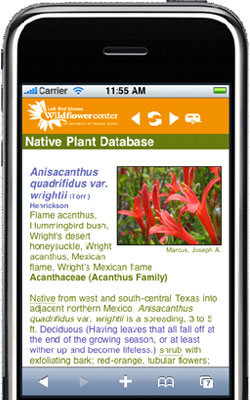
Did you know you can access the Native Plant Information Network with your web-enabled smartphone?
Ask Mr. Smarty Plants
Ask Mr. Smarty Plants is a free service provided by the staff and volunteers at the Lady Bird Johnson Wildflower Center.

rate this answer

Monday - July 12, 2010
From: Lake Charles, LA
Region: Southeast
Topic: Shade Tolerant
Title: Need mowable ground cover for shady area under trees in Lake Charles, LA.
Answered by: Jimmy Mills
QUESTION:
I live in Southwest Louisiana. I have a large portion of my back yard that is very shady because I have large trees in the yard. The area dries up fairly quickly after a heavy rain, so it isn't extremely moist. Nothing really grows there though. I really want some sort of groundcover that I can mow and that my son can walk on. I'm just tired of looking at a yard that is half grass and half dirt. Any suggestions would be appreciated.ANSWER:
You didn't mention the kind of trees or the type of soil that you have in your yard. Both of these factors can influence the kinds of plants that will grow there.
The following is a list of plants that are considered groundcovers that can grow in shady conditions.
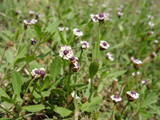
Calyptocarpus vialis (straggler daisy) grows less than 1 foot high. Can be mowed
Geum canadense (white avens) grows from 4 inches to over 3 feet, but can be mowed. It is evergreen if watered in summer.
Phyla nodiflora (turkey tangle fogfruit) grows 3 to 4 inches high and is evergreen to dormant in winter.
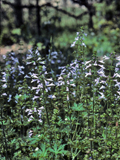
Salvia lyrata (lyreleaf sage) grows 4 to 18 inches or more, but can be mowed and is evergreen if watered in summer.
Packera obovata (roundleaf ragwort) grows 3 inches to 2 feet but can be mowed and is evergreen.
Clicking on the name of the plant will bring up its NPIN page which has infromation about the plant's characteristics, growing conditions and photos.

More Shade Tolerant Questions
Leaves turning brown on geum in Mountlake Terrace WA
July 12, 2010 - Assuming a geum is North American . . . mine are turning brown unlike any time before. They get watered occasionally and then dry out. Is there something special I should be doing for geums? They get ...
view the full question and answer
Full Shade Plants for Muncy PA
April 10, 2014 - I need a suggestion for almost full shade plants for central Pennsylvania.
view the full question and answer
Need evergreen hedge and groundcover for shade in Carmel, Indiana
September 27, 2010 - Our property is bounded by a fencerow that is wooded and mostly shaded by mulberry and hackberry trees during the growing months. We'd like to create a 5'+ tall evergreen barrier on the property li...
view the full question and answer
Shady Container Plant for Austin
August 20, 2014 - I am looking for a tall plant/small shrub/ornamental grass for a very large pot that is placed against the north wall of our Austin home. That spot gets some morning sun in the summer, but virtually ...
view the full question and answer
Native flowering vine for trellis in shade in Henrico, VA
April 07, 2010 - I live in Henrico, Virginia and have a trellis in a shady area. I am looking for a native vine to grow, preferably one that flowers and attracts birds and/or butterflies. What do you advise?
view the full question and answer
| Support the Wildflower Center by Donating Online or Becoming a Member today. |