Native Plants

Q. Who is Mr. Smarty Plants?
A: There are those who suspect Wildflower Center volunteers are the culpable and capable culprits. Yet, others think staff members play some, albeit small, role. You can torture us with your plant questions, but we will never reveal the Green Guru's secret identity.

Did you know you can access the Native Plant Information Network with your web-enabled smartphone?

Ask Mr. Smarty Plants
Ask Mr. Smarty Plants is a free service provided by the staff and volunteers at the Lady Bird Johnson Wildflower Center.

rate this answer

Saturday - June 12, 2010
From: North Liberty, IA
Region: Midwest
Topic: Diseases and Disorders, Trees
Title: Leaf problems on oaks in North Liberty IA
Answered by: Barbara Medford
QUESTION:
My oak trees (young and old) are showing leaf problems. Is there a disease or insect causing oak tree disease?ANSWER:
There are whole books written on pests and diseases of oak trees. In our Native Plant Database there are 78 species of the genus Quercus (oak) native to North America, 14 native to Iowa. In Johnson Co., Iowa you are in USDA Hardiness Zone 4b to 5a. Some of the oaks that are native to Iowa would burn up in Texas, and the Texas oaks would likely have freeze damage in Iowa. Without information on what oak, how old it is, what the leaf symptoms are and how long it has been going on, we couldn't even begin to guess. When we googled "pests and diseases of oak trees," we got a lot of results. We are going to send you links to a few of them so you can look at pictures and read descriptions, which might at least give you a start on identifying problems and treatments, if any. The best and most accurate help can come from the Iowa State University Extension Office for Johnson County. Whatever the problem is, it probably won't be the first time they have heard of it, and they may even have printed materials on what to do.
treehelp.com Oak Trees
USDA Forest Service Sudden Oak Death
gardenguides.com Pests and Diseases of Oak Trees
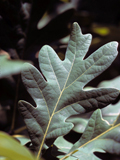
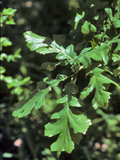
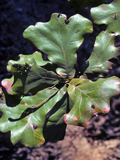
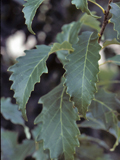
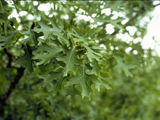
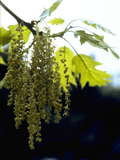
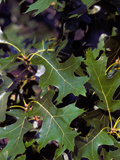
We are going to give you a list of members of the Quercus genus native to Iowa, and pictures of some of them. This doesn't necessarily include the trees you have; there are hybrids, the trees sometimes do their own cross-breeding, and you may have trees from another area.
Members of Quercus Genus Native to Iowa:
Quercus bicolor (swamp white oak) - pictures
Quercus ellipsoidalis (northern pin oak) - pictures
Quercus imbricaria (shingle oak) - photos and more information
Quercus marilandica (blackjack oak)
Quercus muehlenbergii (chinkapin oak)
Quercus palustris (pin oak) - photos and more information
Quercus prinoides (dwarf chinkapin oak) - photos and more information
Quercus rubra (northern red oak)
Quercus rubra var. ambigua (northern red oak)
Quercus rubra var. rubra (northern red oak) - photos
From our Native Plant Database:
More Trees Questions
Daily water absorption of live oak from soil
December 04, 2003 - How much water does the live oak absorb from the soil per day?
view the full question and answer
Small flowering tree for Burbank IL
April 14, 2010 - Looking for a semi-dwarf flowering tree resistant to disease and insects. Current flowering crab has fire blight. What would you suggest planting. We live in a Chicago IL suburb.
view the full question and answer
Control of live oak root sprouts, or suckers, under tree
September 19, 2007 - Have live oak trees in clusters with circular beds surrounding in frontyard. Have been invaded by some type weed that looks a bit like holly. Woody stem a few inches high with several serrated leave...
view the full question and answer
Pruning mature cedar elm trees in San Antonio
September 14, 2008 - When is the right time to prune my several mature cedar elm trees? I'm in San Antonio, and they have never been trimmed in the 55 years we have lived in this home. I have several that are at least 7...
view the full question and answer
Fast-spreading desert-type tree with thorns in yard
July 21, 2014 - There is a fast spreading tree in my backyard - many multiple almost symmetric flat green oval leaves on either side of the stem (sort of like a moringa tree but this is not that). Grows straight up, ...
view the full question and answer
| Support the Wildflower Center by Donating Online or Becoming a Member today. |