Native Plants

Q. Who is Mr. Smarty Plants?
A: There are those who suspect Wildflower Center volunteers are the culpable and capable culprits. Yet, others think staff members play some, albeit small, role. You can torture us with your plant questions, but we will never reveal the Green Guru's secret identity.

Did you know you can access the Native Plant Information Network with your web-enabled smartphone?

Ask Mr. Smarty Plants
Ask Mr. Smarty Plants is a free service provided by the staff and volunteers at the Lady Bird Johnson Wildflower Center.

rate this answer

Saturday - June 05, 2010
From: Smoaks, SC
Region: Southeast
Topic: Non-Natives, Shrubs
Title: Problems with yellow lantana in Smoaks SC
Answered by: Barbara Medford
QUESTION:
My yellow lantanas are about five years old - big and beautiful, but beginning last year, the blooms are small and part of the tiny petals are brown or black. Can you tell me what I can do about this problem? I live in coastal South Carolina.ANSWER:
Lantana is so extensively hybridized that it is almost impossible to diagnose what plant will grow well where. We looked at the 5 species of Lantana that are native to North America: Lantana achyranthifolia (brushland shrubverbena), Lantana involucrata (buttonsage), Lantana urticoides (West Indian shrubverbena), Lantana velutina (velvet shrubverbena) and Lantana canescens (hammock shrubverbena). Of these, only Lantana urticoides (West Indian shrubverbena) is listed as being native to South Carolina; furthermore, none of the five has yellow blooms. It is more likely that what you have is Lantana camara, a tropical native to Mexico, Central and South America. At the Lady Bird Johnson Wildflower Center we are dedicated to the growth, protection and propagation of plants native not only to North America but also to the area in which they are growing.
We looked at the USDA Plant Profile for this plant, and found that it is growing in at least one coastal county of South Carolina, in the southeastern portion of the state. Just as an opinion, since we really don't know anything about the plant itself, the problems your plant is having could be a deficiency in the soil, possibly iron. A judicial addition of a soil amendment featuring iron is worth a try. Our second thought is that it may be the victim of a herbicide spraying, possibly not even on your property, but a drift from somewhere else in the neighborhood. Two other websites that we found that could give you some clues are Floridata Lantana camara and Dave's Garden forum Lantana camara.
Pictures of Lantana camara from Google
Pictures of Lantana involucrata (buttonsage) from Google
From our Native Plant Image Gallery:

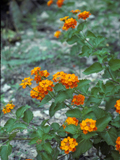
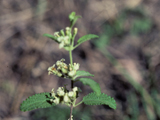
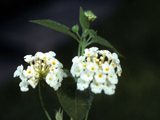
More Shrubs Questions
Advice for Texas Mountain Laurel in shady, narrow bed.
June 08, 2015 - My house faces N/NE and gets a lot of shade. I would like to plant a Texas Mountain Laurel in my narrow front bed, but what is the best way to amend my clay soil since it prefers rocky soil? What woul...
view the full question and answer
Potted Plumbago, struggling with the heat, in Spring Texas
June 29, 2011 - Why do some of the leaves of my plumbagos that are grown in large, well-draining planters turn brown? The brown starts on the tips, then extends to the whole leaf. They get several hours of west aft...
view the full question and answer
Evergreen vine for wall and long-blooming shrubs in San Antonio TX
May 04, 2014 - What is a good native vine that stays green all year to plant along a rock courtyard wall? Also what are native bushes that flower for the longest period of time? Thanks.
view the full question and answer
Shrubs for North Myrtle Beach, South Carolina
March 19, 2010 - What shrubs can I plant on the west-facing side of my home? The way the house sits, these shrubs will only get 2-3 hours of sun, but those 2-3 hours are end-of-the-day hot! Thanks!!
view the full question and answer
Shrub or small tree for hedgerow to block view
November 06, 2007 - For property in the Post Oak Savanah area of Eastern Texas, north of Bryan, Texas, I would like to plant a native hedgerow to block the view of a neighboring property. Ideally this would be a shrub t...
view the full question and answer
| Support the Wildflower Center by Donating Online or Becoming a Member today. |