Native Plants

Q. Who is Mr. Smarty Plants?
A: There are those who suspect Wildflower Center volunteers are the culpable and capable culprits. Yet, others think staff members play some, albeit small, role. You can torture us with your plant questions, but we will never reveal the Green Guru's secret identity.

Did you know you can access the Native Plant Information Network with your web-enabled smartphone?

Ask Mr. Smarty Plants
Ask Mr. Smarty Plants is a free service provided by the staff and volunteers at the Lady Bird Johnson Wildflower Center.

rate this answer

Thursday - April 15, 2010
From: McKinney, TX
Region: Southwest
Topic: Compost and Mulch, Soils, Poisonous Plants, Privacy Screening, Shrubs
Title: Evergreen pet-safe shrubs for house and screening in McKinney TX
Answered by: Barbara Medford
QUESTION:
Looking for shrub, preferably evergreen, to plant near the house that can handle wet ground and is pet (dog, cat, horse) safe. The area became boggy after we had an underground water leak that is now fixed, but it remains wet over a year after and killed the previous large shrub (which I have no idea of its name). Also would like to know a good "screening" shrub to plant along fences to provide some privacy. Again - must be pet safe. Thanks so much!ANSWER:
We will certainly see what we can find that is native in and around Collin County in north central Texas, and determine that whatever we suggest is not on any of the "poisonous to pets" lists that we have access to. However, before we do that, we need to address what killed the last plant you had, which died because of the soil being too wet. What is causing that soil to remain so wet? Is it in a low spot which never drains? Or maybe under the roof overhang where water pours off the roof when it rains? Even a plant which likes wet soil cannot tolerate it all the time, without some opportunity for drainage. You probably have an alkaline, clay soil; as the water goes into that soil, the particles swell, until there is no opportunity for gases, like oxygen, to get to the roots nor can those roots access nutrients in the soil. If it sheets off the roof in rainy weather, you should consider guttering to divert the water, or not try to have a flower bed there at all. If it's low, without good drainage, try working a lot of compost into the soil-not just spreading it around but digging it in, turning the soil over and raising the level of the soil. Raised beds are always a good idea when there is clay soil or poor soil or bad drainage. From Popular Mechanics, here is our favorite article on Building Raised Garden Beds. They don't have to be as constructed or complicated as some of the ideas in this article, but the principle makes sense.
It is getting late in the season to be planting woody plants at all. Unless you can address the wet area and get the screen shrubs into place pretty soon, you really should wait until late Fall. And don't buy anything until the holes are dug and the soil is ready to go. Those plants have already been stressed enough by being transplanted from the growing fields into plastic pots, being transported and then sitting in the nursery for however long. Make sure the stock looks fresh and pull every root ball out of its pot to make sure it is not root bound. If roots are not cut before they are transplanted, the woody plant will eventually be strangled by its own roots.
The part about being poisonous isn't too difficult to handle; it's the "evergreen" that always causes us problems. We can't fall back on the good old standby of members of the Ilex (holly) genus like Ilex vomitoria (yaupon) that will grow nearly anywhere and is evergreen. Unfortunately, the plant is also considered toxic, so never mind that.
Here is a list of websites on poisonous plants to which you can refer when choosing plants:
Toxic and Non-Toxic Plant List—Horses
Poisonous Plants of North Carolina
Cornell University Plants Poisonous to Livestock
University of Pennsylvania Poisonous Plants
Canadian Poisonous Plants Information System
Toxic Plants from the University of California-Davis
Pennsylvania's Poisonous Plants from the Universtiy of Pennsylvania
Cornell University Plants Poisonous to Livestock
ASPCA list of Plants Toxic to Horses
Horse Nutrition: Poisonous Plants from Ohio State University Extension Service
10 Most Poisonous Plants for Horses from Equisearch
PullmanUSA - plants poisonous to both cats and dogs
We looked at every one of them for the two plants we have chosen, and found no indication that any part of them was poisonous. Follow the plants links to our page on each plant in our Native Plant Database to learn more about it.
Evergreen, Non-Poisonous Plants for McKinley TX:
Mahonia trifoliolata (agarita)
From our Native Plant Image Gallery:
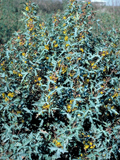
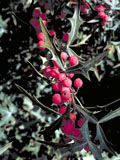
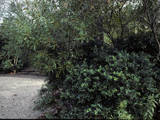
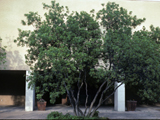
More Shrubs Questions
Irrigation of landscaping project after 1 year in San Antonio
November 10, 2010 - Hello, I am working on a project in San Antonio where the following vegetation types have been specified: cedar elm, bald cypress, 'Tifway 419' bermuda grass, mountain laurel, esperanza, and lantana...
view the full question and answer
Native shrub for Chesterfield VA
April 02, 2014 - Need a native shrub for the north side of our house that is deer resistant, not overly sensitive to wind, and can tolerate clay soil. Preferably 3-8 feet. Thanks for your help.
view the full question and answer
Dwarf evergreen shrub for windowboxes in Staten Island , NY
April 03, 2008 - Dear Mr. Smarty Plants,
Could you recommend a dwarf evergreen shrub, not deciduous that also has pretty flowers that would thrive in a container in the northeast...area would have sun for about 4 -5...
view the full question and answer
Need help for diseased Cherry Laurel tree in Houston
October 19, 2015 - A couple of weeks ago the leaves on my decade old cherry laurel began to turn brown. Now they are entirely brown. I have not changed the way in which I cared for it, but about three days ago I noticed...
view the full question and answer
Removal of pods when pruning Tecoma stans
May 10, 2013 - When pruning Tecoma stans for growth and shape control,should I cut off the pods?
view the full question and answer
| Support the Wildflower Center by Donating Online or Becoming a Member today. |