Native Plants

Q. Who is Mr. Smarty Plants?
A: There are those who suspect Wildflower Center volunteers are the culpable and capable culprits. Yet, others think staff members play some, albeit small, role. You can torture us with your plant questions, but we will never reveal the Green Guru's secret identity.
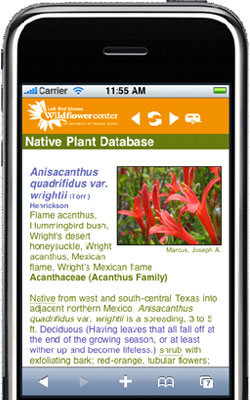
Did you know you can access the Native Plant Information Network with your web-enabled smartphone?
Ask Mr. Smarty Plants
Ask Mr. Smarty Plants is a free service provided by the staff and volunteers at the Lady Bird Johnson Wildflower Center.

rate this answer

Wednesday - February 24, 2010
From: Llano, TX
Region: Southwest
Topic: Trees
Title: What is the pH of Bald Cypress needles?
Answered by: Nan Hampton and Joe Marcus
QUESTION:
What is the pH of Bald Cypress needles?ANSWER:
Sorry, but, after an extensive search, Mr. Smarty Plants couldn't find a precise answer to your question. We can tell you that, according to the USDA Plants Database, the pH requirements for its growth are 4.0 minimum and 6.5 maximum and we can point you to the US Forest Service account with a wealth of information about bald cypress.
We do wonder why you asked the question. Are you considering using Taxodium distichum (bald cypress) needles as mulch for your garden and hoping to lower the pH of your soil to help particular plants? If that's the case then there isn't an easy answer to the exact results. The overall effect of bald cypress needles on basic soils should be acidifying, but there are many factors that will affect how much the pH could be changed—the amount of needles and how they're used, original soil pH, soil mineral fractions, water quality and its pH, amount of rainfall, soil biota, etc.
There is some experimental evidence about the effect of cypress mulch on soil acidity. Cypress mulch is the shredded whole tree (including the needles). A study in Florida by Stephen H. Brown of the Lee County Cooperative Extension Service ("Response of Hibiscus to Organic Mulches", Proc. Fla. State Hort. Soc. 109:30-33. 1996) compared the effects of five organic mulches—needles of Pinus elliottii (slash pine), municipal solid waste (MSW) composed of refuse from professional landscapers and homeowner lawn organic waste, and shredded mulch from three trees—Taxodium distichum (bald cypress) and two trees that are native to Australia, Melaleuca quinquenervia (Melaleuca) and Eucalyptus sp. (no particular species named) on the growth of Chinese hibiscus (Hibiscus rosa-sinenesis). Interestingly, they found that all applications decreased the pH of the soil (made it more acidic—going from a range of 7.37-7.63 to a range of 6.47-6.8), but the amounts of the decrease were not significantly different for the 5 treatments or the control with no mulch added. The cypress mulch lowered the pH of the soil from 7.37 to 6.47 in one year.
More Trees Questions
Protecting live oaks when removing jasmine in Austin
December 03, 2010 - Thank you for your answer to my question of eliminating a 25-year-old bed of Asian Jasmine. I have another question. There is a stand of live oak trees in this bed and as we are digging out the jasmi...
view the full question and answer
Reason for tree canopy dieback from Mahopac NY
May 21, 2012 - Dear Mr. Smarty Plants: Not a questions, just sharing, re person in Texas whose Ash Jupiter appeared to be dying "canopy very thin on top". We moved to Putnam Co. NY in 1970. Our house was shaded by...
view the full question and answer
List of trees native to Texas
May 22, 2009 - I am terribly sorry but, I just found out about this school project; leaves from Texas native trees. I gathered leaves and, now, tonight, Mr. Student advises that they must be native to Texas. Typic...
view the full question and answer
What is causing leaf drop on oak in Morgan Hill CA?
June 23, 2010 - Dear Mr Smarty Plants: We have a large, young Valley Oak (about 20 yrs) which is dropping leaves even now in early summer. I have a feeling that the problem might be an invasive weed that is flourishi...
view the full question and answer
Stump sprouting of Oak trees in the wildfire area in Bastrop, TX.
May 13, 2012 - We live in Bastrop, Texas, in the wildfire area. We lost all of our trees. The oak trees have "suckers" growing from the base of the burned tree that has been cut down. They look like little bushe...
view the full question and answer
| Support the Wildflower Center by Donating Online or Becoming a Member today. |