Native Plants

Q. Who is Mr. Smarty Plants?
A: There are those who suspect Wildflower Center volunteers are the culpable and capable culprits. Yet, others think staff members play some, albeit small, role. You can torture us with your plant questions, but we will never reveal the Green Guru's secret identity.
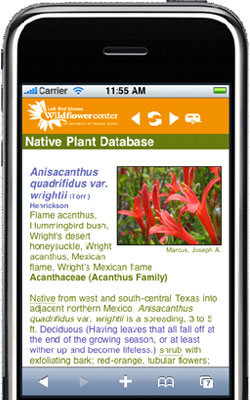
Did you know you can access the Native Plant Information Network with your web-enabled smartphone?
Ask Mr. Smarty Plants
Ask Mr. Smarty Plants is a free service provided by the staff and volunteers at the Lady Bird Johnson Wildflower Center.

rate this answer

Wednesday - November 25, 2009
From: Kyle, TX
Region: Southwest
Topic: Turf
Title: Need help with an invasive ground cover type plant filling in damaged areas in lawn.
Answered by: Jimmy Mills
QUESTION:
Since the drought this summer, there is an invasive ground cover type plant filling in the damaged areas in my lawn . It is dark greenish/purplish very small clover type plant, difficult to pull up and breaks off close to the ground. It's spreading like wild fire. Do you have any suggestions? I live 20 minutes south of Austin, Texas.ANSWER:
It is generally difficult, if not impossible, to identify a plant from a written description, but you have given a clue that makes Mr. Smarty Plants think you may be talking about a plant in the genus Oxalis. Compare the images on this page for Oxalis with the plant in your yard. You didn't mention flowers, but if the plant is flowering, it it much easier to identify. If the images on the NPIN page don't match your plant, go to the Plant Identification page and follow the directions for sending us some photos.
Oxalis is a broad-leaf weed, and there are herbicides that can control it. We generally don't recommend their use, but we don't condemn their use either. We just ask that you use them carefully, and strictly follow the directions on the label.
You didn't mention the kind of lawn, the type of damage, or the size of the damaged area. Mechanical removal, ie. pulling, can be an effective means of getting rid of the pest if the area isn't too large. As your lawn recovers, the grasss could choke out the invader, so you might just leave it alone and see what the grass does.

More Turf Questions
Replacing a Grass Lawn with Moss
January 02, 2010 - I have a small north facing yard that I would like to change from grass to moss. There is some moss now but still lots of grass. I need to rake a lot of leaves in the fall but want to get away from a ...
view the full question and answer
Las Vegas lawn grass for Dallas
February 13, 2009 - Dear Smarty Plants,
Every time we go to Las Vegas I admire the beautiful grass in the lawns of most of the strip casinos. It looks like a fescue but it is just as beautiful on the hottest summer day...
view the full question and answer
Native grasses and turf grass for VA
February 08, 2012 - I recently moved to Blacksburg, Virginia. I am becoming involved with a church here that recently started a grounds committee. There is some discussion within the group of which varieties of native ...
view the full question and answer
How to make a lawn into a prairie in Arlington, Texas
September 15, 2010 - I am removing lawn grasses in order to start a native prairie meadow. After grass removal, I'll put down 1/2" of compost. I will broadcast wildflower seeds on the compost. If I mulch after broadcas...
view the full question and answer
Mowing the multi-species buffalo grass lawn
June 23, 2011 - I am planning on putting in a buffalo grass lawn in an area that is little used. I read that a mix of buffalo, blue grama, and curly mesquite is good for better cover but I am concerned about the blu...
view the full question and answer
| Support the Wildflower Center by Donating Online or Becoming a Member today. |