Native Plants

Q. Who is Mr. Smarty Plants?
A: There are those who suspect Wildflower Center volunteers are the culpable and capable culprits. Yet, others think staff members play some, albeit small, role. You can torture us with your plant questions, but we will never reveal the Green Guru's secret identity.
Did you know you can access the Native Plant Information Network with your web-enabled smartphone?

Ask Mr. Smarty Plants
Ask Mr. Smarty Plants is a free service provided by the staff and volunteers at the Lady Bird Johnson Wildflower Center.

rate this answer

Monday - October 26, 2009
From: Mt. Hope, AL
Region: Southeast
Topic: Non-Natives, Shrubs
Title: Rose varieties for Alabama
Answered by: Jackie OKeefe
QUESTION:
What climate and soil types will Rosa Rogosa, a plant that grows in MA, require?ANSWER:
At the Lady Bird Johnson Wildflower Center, we study and encourage the use of native plants in their native habitats. Rosa rugosa, Japanese rose, a native of eastern Asia - Japan, Korea, China - where it is common to shores and dunes, is outside of our purview. It prefers acidic soil, but tolerates a wide range of soils and climates (zones 2-9), and is becoming an invasive species in some areas. It is very commonly used in more northern climates because of its cold tolerance. As a natural denizen of shorelines, it is salt-tolerant. The UDSA Plant Database distribution map shows that in the north and north-central parts of the U.S. it has moved out of cultivation and naturalized to compete with the native vegetation. A good thumbnail description of the plant and its characteristics can be found here.
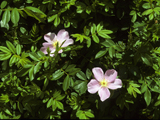
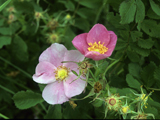
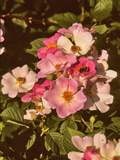
There are several species of rose which are native to Alabama. Rosa palustris (swamp rose) grows in moist to wet conditions. Rosa carolina (Carolina rose) and Rosa virginiana (Virginia rose) grow in meadows and thickets and on beaches. Rosa setigera (climbing rosa) can climb or trail and is a suggested native substitute for Rosa rugosa.
Rosa virginiana (Virginia rose)

More Non-Natives Questions
Identification of tree with red feathery leaves
March 08, 2012 - What is the name of a tree with dark red leaves, feathery, slim trunk; maybe in the pepper family? Jedi?
view the full question and answer
Care for non-native, invasive Bauhinia variegata
March 03, 2006 - I live in Fellsmere just south of Melbourne and we have about 5 orchid trees on our property; one is fairly tall, about 20 ft, and the others are about 6 ft tall. My smaller ones have several air p...
view the full question and answer
Identification of stem from a bouquet
January 02, 2012 - I have a stem with leaves that came in a bouquet May 2011. They are still healthy in a vase of water tho they have no roots, just stem. On the back center of each leaf are protrusions half an inch lon...
view the full question and answer
Invasive, non-native Eragrostis cilianensis, stink grass
March 22, 2005 - I am writing a children's book for Darby Creek Publishing about smelly plants and animals. I have read that Eragrostis cilianensis is one of the few bad-smelling grasses. Would the purpose of the o...
view the full question and answer
Transporting a plant on airplane from New York City
April 21, 2012 - Can I transport via airplane a jade plant from New York City to Colorado in my suitcase?
view the full question and answer
| Support the Wildflower Center by Donating Online or Becoming a Member today. |