Native Plants

Q. Who is Mr. Smarty Plants?
A: There are those who suspect Wildflower Center volunteers are the culpable and capable culprits. Yet, others think staff members play some, albeit small, role. You can torture us with your plant questions, but we will never reveal the Green Guru's secret identity.
Did you know you can access the Native Plant Information Network with your web-enabled smartphone?

Ask Mr. Smarty Plants
Ask Mr. Smarty Plants is a free service provided by the staff and volunteers at the Lady Bird Johnson Wildflower Center.

rate this answer

Thursday - October 01, 2009
From: Brewerton, NY
Region: Northeast
Topic: Shade Tolerant
Title: Should Solanum eleagnifolium, silverleaf nightshade, be removed from yard
Answered by: Nan Hampton
QUESTION:
I live in Upstate NY. I'm quite sure, after checking many sites/pictures, that I have a couple specimens of Silver Leaf Night Shade (Solanum elaeagnifolium) growing in the "wild" portion of my side yard. I've read that it's poisonous, and considered a noxious weed in the western states, but I'm not sure whether or not to remove it. My general policy has been to leave native plants unmolested, but there appears to be some question as to whether or not it's native to North America.. or South. It has also been given a very low rating Food, etc value in the US plant database. Should I pull out this plant?ANSWER:
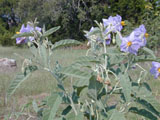
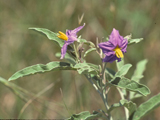
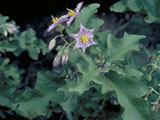
Upstate New York seems to be a bit out of range for Solanum eleagnifolium (silverleaf nightshade) according to the USDA Plants Database distribution map, but I suppose not an impossibility. S. carolinense (Carolina horsenettle) does occur in Onondaga County, New York but should be easily distinguished from S. eleagnifolium (see below) by the leaf shape. Solanum physalifolium (hairy nightshade), a South American native, does occur near Onondaga County and looks a bit like S. eleagnifolium. If you would like for us to confirm the identify of the species, please send us photos and we will try our best to do so. Visit Mr. Smarty Plants' Plant Identification page to read instructions for submitting photos.Whichever one it is, however, it is really pretty much a matter of your choice whether to remove or not. Many people would say that all of these are ugly weeds, but one person's weed is another person's wildflower. I happen to think they are rather pretty myself. Cornell University's Plants Poisonous to Livestock database lists the leaves and immature fruit of all species of Solanum as toxic. This shouldn't necessarily be a problem for you unless you have small children or animals that might eat the leaves or the immature fruit. Of the three, the USDA says that only S. physalifolium is an introduced species so I would recommend removing it, if that is what you have.
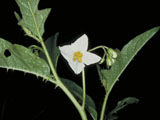
Photos of S. elaeagnifolium:
Photos of S. carolinense:
More Shade Tolerant Questions
Replacing mature Arizona Ash trees in Austin
August 26, 2011 - Mr. Smarty Plants,
I have 2 very large, very old Arizona Ash trees in my yard. I want to remove them and replace them with something like Cedar Elm or Chinquapin Oak. The problem is that they are t...
view the full question and answer
Tree and vine for shade and privacy
June 03, 2008 - We recently added a deck in our backyard which faces west, we live in Circle C (southwest Austin). The afternoon sun is intense so we're looking to plant something along our fence line to provide sh...
view the full question and answer
Why doesn't my Rusty blackhead bloom?
April 10, 2016 - I have planted Rusty blackhaws the past several years..some bloomed the first year and every year since....and others 3 years old have not bloomed yet...
Do all Rusty blackhaws bloom eventually or ...
view the full question and answer
Tree as shade alternative to carport in Austin
April 21, 2010 - Hello,
I'm looking for a small tree that could provide afternoon shade for two cars, as an alternative to a carport. When mature, the tree would need to be tall enough to grow around (and above) the...
view the full question and answer
Balancing bloom in beds in Kents Store VA
May 26, 2010 - Our beds along a walkway in rural Central VA have replanted themselves - oenethera speciosa and dwarf yarrow have abandoned the north bed and are flourishing in the south bed. Sedums, lavender and can...
view the full question and answer
| Support the Wildflower Center by Donating Online or Becoming a Member today. |