Native Plants
Q. Who is Mr. Smarty Plants?
A: There are those who suspect Wildflower Center volunteers are the culpable and capable culprits. Yet, others think staff members play some, albeit small, role. You can torture us with your plant questions, but we will never reveal the Green Guru's secret identity.
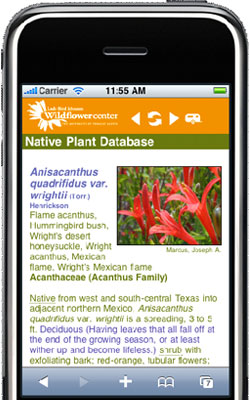
Did you know you can access the Native Plant Information Network with your web-enabled smartphone?

Ask Mr. Smarty Plants
Ask Mr. Smarty Plants is a free service provided by the staff and volunteers at the Lady Bird Johnson Wildflower Center.

rate this answer

Monday - September 21, 2009
From: Fairfax, VA
Region: Mid-Atlantic
Topic: Trees
Title: Small native flowering tree for Virginia
Answered by: Nan Hampton
QUESTION:
Could you recommend a small flowering tree (8-10' mature size) to plant in front garden next to the house. Full sun. Something that doesn't have invasive roots that would damage the house. Thanks SheilaANSWER:
Mr. Smarty Plants recommends that you go to our Recommended Species page and choose Virginia from the map or pulldown menu. This will give you a list of native plants that are commercially available and are recommended for landscaping in Virginia. You can use the NARROW YOUR SEARCH option to add your preferences for General Appearance, Light Requirement, Soil Moisture, etc. Here are a few from that list that would meet your criteria pretty well:Physocarpus opulifolius (common ninebark)
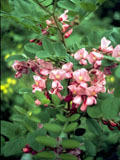
Robinia hispida (bristly locust)
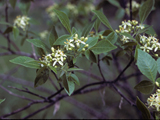
Viburnum dentatum (southern arrowwood)
Here are a few that are a little taller than your stated preference:
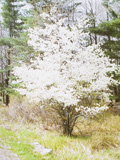
Amelanchier canadensis (Canadian serviceberry)
Prunus americana (American plum)
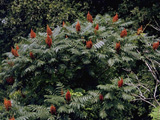
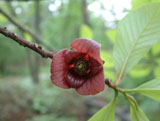
Ptelea trifoliata (common hoptree)
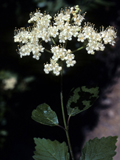
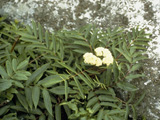
Sorbus americana (American mountain ash)
It will matter how close your tree is planted to your house as to whether or not the roots will harm your foundation. You can read the recommendations from Iowa State University Extension Service for Sidewalks and Trees which bases the distance trees should be planted near pavement on the mature height of the tree. Their recommendations are:
1. trees with a mature height of less than 30 feet, 3-4 feet from pavement,
2. trees with a mature height of 30 to 50 feet, 5-6 feet from pavement,
3. trees with a mature height of greater than 50 feet, at least 8 feet from pavement.
You could consider installing some sort of root barrier between the tree and the foundation. Here is more information about root barriers.
More Trees Questions
Yellow, pale green leaves on Cedar Elms in Texas
August 30, 2008 - I have had several cedar elms of various sizes planted in our yard over the last 10 years. Only the largest has dark green, healthy looking leaves. All the others have yellowish, pale green leaves. Th...
view the full question and answer
Yard Trees for Burleson, TX
July 24, 2011 - We need to replace 2 mature pear trees in our front yard, north side of the house in Burleson, TX. We are looking for faster growing trees that will last for decades that resist disease in clay soil....
view the full question and answer
Need plants to provide a privacy screen in Cedar Creek, TX
March 31, 2015 - We need to screen out neighbor's house. What can we plant (fast growing tree or hedge) in partial shade? Area is dry in summer, but does get soggy during heavy rain. We live east of Austin in Cedar C...
view the full question and answer
Small native trees for northern Virginia
September 27, 2011 - Mr. Smarty Plants, I am looking for a native alternative to a Japanese Red Maple in northern Virginia. I would like a small tree that I can put in my front garden that will not pose a security risk my...
view the full question and answer
Fertilizing oaks to produce acorns
January 16, 2012 - Will fertilizing oak trees help with acorn production?
view the full question and answer
| Support the Wildflower Center by Donating Online or Becoming a Member today. |