Native Plants

Q. Who is Mr. Smarty Plants?
A: There are those who suspect Wildflower Center volunteers are the culpable and capable culprits. Yet, others think staff members play some, albeit small, role. You can torture us with your plant questions, but we will never reveal the Green Guru's secret identity.

Did you know you can access the Native Plant Information Network with your web-enabled smartphone?

Ask Mr. Smarty Plants
Ask Mr. Smarty Plants is a free service provided by the staff and volunteers at the Lady Bird Johnson Wildflower Center.

rate this answer

Tuesday - September 15, 2009
From: Hutto, TX
Region: Southwest
Topic: Plant Identification
Title: Plant identification of Texas bullnettle (Cnidoscolus texanus)
Answered by: Nan Hampton
QUESTION:
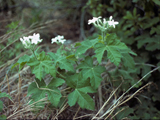
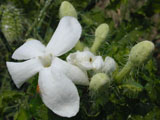
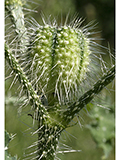
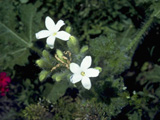
I'm trying to identify a small thorny plant that I found growing on our (previously undeveloped) dry lot in Hutto, Central Texas. It has small white flowers and green thorny bulbs. The leaves and stems are also thorny. It gave my foot an allergic reaction and I'd like to know the best way to keep it from coming back into my yard. The soil was previously very dry (throughout the worst drought in Central Texas history) and these plants popped up. Then after the rain in the past week, they grew very quickly. Hutto soil is generally black clay but our lot has very shallow soil on top of a rock shelf. Thank you.ANSWER:
The plant you describe (and thank you for the photos you sent) is Cnidoscolus texanus (Texas bullnettle). The spines on them can provide quite a sting.If you were extremely careful, wearing protective clothing and heavy gloves, you could probably dig the plants up. The Bandera County Courier also has some information on controlling it. There are likely to be more, though, growing from seeds deposited there by wildlife. The seeds, once you get to them, are quite tasty for wildlife and humans as well. Delena Tull (page 76) of Edible and Useful Plants of Texas and the Southwest explains how to get into the delicious fruit.
More Plant Identification Questions
Identification of tree bought from a magazine ad
August 11, 2013 - I recently submitted the following question to Ask An Expert. They were unable to identify the plant. I hope you will be able to.
Can you help me by either identifying this plant or advising me a...
view the full question and answer
Plant identification
June 16, 2012 - Hello Mr. Smarty Plants:
We conducted an Internet search to find a name for a plant we have that has 2 opposing leaves on stalks, and is starting to grow a purple flower in the middle, near the groun...
view the full question and answer
Plant identification
May 06, 2010 - My neighbor has a few trees in his pasture that his horses love to eat the fruit off of. The fruit looks like a lemon but smaller and has lots of seeds inside of it. The trees have very long thorns on...
view the full question and answer
Need Plant Identification from Bon Aqua, Tennessee?
September 01, 2010 - By a creek, I found a plant that I have never seen in my life. It has a tall stalk and has leaves like a weed or grass, and the flower looks like a pine tree. The plant looks like a mix of a grass, a...
view the full question and answer
Plant identification
June 10, 2010 - I have a tall leafy green plant growing in my garden. It has long flowering limbs that bear a pod that looks like a tiny green pepper. It then turns purple and falls off. The flower that remains is...
view the full question and answer
| Support the Wildflower Center by Donating Online or Becoming a Member today. |