Native Plants

Q. Who is Mr. Smarty Plants?
A: There are those who suspect Wildflower Center volunteers are the culpable and capable culprits. Yet, others think staff members play some, albeit small, role. You can torture us with your plant questions, but we will never reveal the Green Guru's secret identity.

Did you know you can access the Native Plant Information Network with your web-enabled smartphone?

Ask Mr. Smarty Plants
Ask Mr. Smarty Plants is a free service provided by the staff and volunteers at the Lady Bird Johnson Wildflower Center.

rate this answer

Tuesday - May 26, 2009
From: Garland, TX
Region: Southwest
Topic: Vines
Title: Removing spent flowers from passion flower in Garland TX
Answered by: Barbara Medford
QUESTION:
To encourage more blooms, should I remove spent flowers on my passion flower vine?ANSWER:
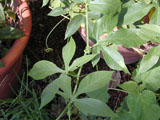
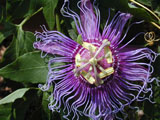
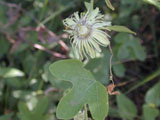
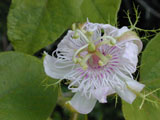
There are several members of the Passiflora genus that are native to Texas: Passiflora affinis (bracted passionflower), Passiflora foetida (fetid passionflower) and Passiflora incarnata (purple passionflower). Most of them are native to South or South Central Texas. So, we chose the most glamorous one, Passiflora incarnata (purple passionflower) to use as an example. Since it is not native to North Central Texas, we are assuming that what you have is one purchased from a nursery.
Our webpage on that plant says: "To encourage bushiness, pinch the plants back during their first growing season." So, obviously, it won't hurt the plant to be pinched back, or flowers pinched off. Most flowering plants will be inspired to bloom again if the bloom is removed before the seed forms. The main purpose of a flowering plant is to make more plants just like it; in order to do this it has to set seed. If the flower is taken off before the plant does that, it will just go in and make more flowers. Now, there is a limit to that. Making flowers and seeds is a high-energy proposition for the plant, but if the plant is happy where you are growing it, it should do just fine. In fact, the first thing a passionflower does when it is planted is start putting out suckers. In Garland, where it is not native, it probably won't be so invasive, but in East Texas, they can simply take over.
You might find this article interesting from Floridata, Passiflora incarnata.
More Vines Questions
Difference between invasive Chinese and Japanese wisterias and native wisteria
September 12, 2014 - Dear Mr or Ms Smarty Plants,
Is there any way I can tell for sure if my wisteria is native? I bought it at a place when it was in bloom that sold a lot of native plants. I Would like to know for sure...
view the full question and answer
Will Hyacinth Beans and Cardinal vine (non-natives) grow in Texas?
April 28, 2007 - I live in Coppell, TX, and a neighbor gave me some Hyacinith Beans and Cardinal Vine seeds to plant. She described these as doing well in her local garden, but I cannot find a photo or picture of them...
view the full question and answer
Non-Toxic Flowering Vine for Sunny Trellis in California
March 12, 2015 - I am looking for a flowering trellis plant that is non-toxic to my dog, will grow in the California area that I live in, and will be in full sun.
view the full question and answer
Non-native vines poisonous to animals from Park Ridge IL
June 18, 2012 - I have a Star Jasmine and sambac Philipine Jasmine Plant . Are they poisonous to cats or dogs. I have them in the house.
view the full question and answer
Vine for shady planter from Cedar Park TX
April 19, 2014 - We bought a home in Central Texas and inherited several raised-bed planters. One of the planters is set up to grow a vine, but it's in a part of the yard that is mostly in the shade of a tree. Is t...
view the full question and answer
| Support the Wildflower Center by Donating Online or Becoming a Member today. |