Native Plants

Q. Who is Mr. Smarty Plants?
A: There are those who suspect Wildflower Center volunteers are the culpable and capable culprits. Yet, others think staff members play some, albeit small, role. You can torture us with your plant questions, but we will never reveal the Green Guru's secret identity.

Did you know you can access the Native Plant Information Network with your web-enabled smartphone?

Ask Mr. Smarty Plants
Ask Mr. Smarty Plants is a free service provided by the staff and volunteers at the Lady Bird Johnson Wildflower Center.

rate this answer

Saturday - May 02, 2009
From: North East, MD
Region: Mid-Atlantic
Topic: Herbs/Forbs
Title: Non-blooming blue-eyed grass in Northeast Maryland
Answered by: Barbara Medford
QUESTION:
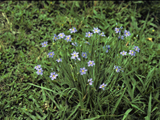
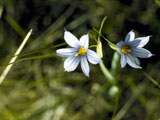
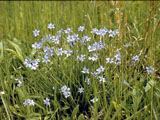
I purchased blue eyed grass(sisyrinchium angustifolium)It was in bloom when I planted it, but has never bloomed since. It looks healthy and gets full sun, but for at least 3 years or more, it has never bloomed. Please help...ANSWER:
From our webpage on Sisyrinchium angustifolium (narrowleaf blue-eyed grass), we learned that it is NOT a grass, but rather a primitive iris, and member of the Iridaceae family. We also found out that this short-lived perennial will decline if allowed to dry out. Heavy mulch causes crown rot and rich, organic soils encourage rank, vegetative growth. Plants need to be divided at least every other year. It is native to Maryland and, while it likes semi-shaded conditions, it blooms better in the sun. What we never did learn was why it is not blooming for you. About the only suggestion we can make at this point is that you avoid fertilizing it, especially with high-nitrogen fertilizers, like you would use on a real grass. Honestly, it sounds like it does better when it's neglected a little bit, not in rich organic soils, not fertilized. Try a little benign neglect, and see if it doesn't get its act together. Plants all need to reproduce and to reproduce they must bloom and produce seeds. If life is too easy for your blue-eyed grass, it might just roll over and go back to sleep, forgetting to wake up and bloom.

More Herbs/Forbs Questions
Drought-resistant plants for Paradise, California
January 23, 2009 - We are moving to a new home in Paradise, CA. What drought resistant plants do well in Paradise ?
Thank you !!
view the full question and answer
Aquatic Plants for a Small Pond in Missouri
June 11, 2015 - We have a small backyard pond (4' x 5' x 2' deep) with a shelf for marginal plants, and a pump that feeds a nice little creek and waterfall into the pond. We don't really want fish, but we'd lik...
view the full question and answer
Native alternative for liriope
September 20, 2011 - I am looking for native alternatives to liriope for use in sun to part shade, moderate moisture planting beds. Would prefer evergreen options.
view the full question and answer
Caterpillars devouring Blue Wild Indigo in Jesup GA
September 05, 2011 - I have a false blue indigo growing in my garden. Every spring it gets defoliated by Genista moth caterpillars. It usually doesn't put out new growth until the next spring. This summer, it has put ...
view the full question and answer
Possible mildew on standing cypress
May 29, 2008 - My mother-in-law took some standing cypress seeds from Texas to Virginia several years ago. They have always done very well, but this year they are growing very tall, but the bottom half of the stalk...
view the full question and answer
| Support the Wildflower Center by Donating Online or Becoming a Member today. |