Native Plants

Q. Who is Mr. Smarty Plants?
A: There are those who suspect Wildflower Center volunteers are the culpable and capable culprits. Yet, others think staff members play some, albeit small, role. You can torture us with your plant questions, but we will never reveal the Green Guru's secret identity.
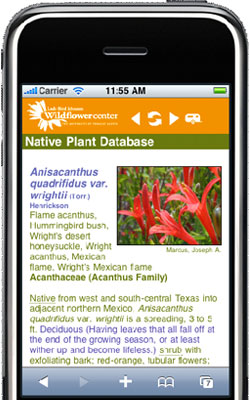
Did you know you can access the Native Plant Information Network with your web-enabled smartphone?

Ask Mr. Smarty Plants
Ask Mr. Smarty Plants is a free service provided by the staff and volunteers at the Lady Bird Johnson Wildflower Center.

rate this answer

Saturday - April 25, 2009
From: Salisbury, CT
Region: Mid-Atlantic
Topic: Grasses or Grass-like
Title: Native plants to retain slope in Salisbury, CT
Answered by: Barbara Medford
QUESTION:
We want to plant a newly dug out slope with native plants that will retain the dirt. It is sun to part sun near a lake summer cottage. Thanks!!!ANSWER:
The best thing for retention of that slope would be a meadow garden, which combines grasses, which are world class erosion preventers, and wildflowers for a pleasant view from your cottage. Begin by reading our How-To Article, Meadow Gardening. We will follow up by going to our Recommended Species section, clicking on Connecticut on the map, and searching for grasses and wildflowers native to your area that you can plant. You can repeat the same process, going to the Native Plant Database for the grasses, and make your own choices. Follow the plant links to each individual plant webpage to learn propagation techniques, amount of moisture needed,etc.
Herbaceous blooming plants
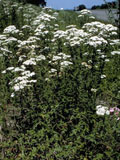
Achillea millefolium (common yarrow) - perennial, 1 to 3 ft. tall, blooms white, pink April to September, sun, part shade
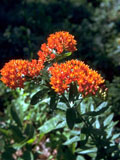
Asclepias tuberosa (butterfly milkweed) - perennial, 1 to 2 ft., deciduous, blooms orange, yellow May to september, sun, part shade
Anemone canadensis (Canadian anemone) - perennial, 1 to 2 ft., blooms white April to June, part shade, shade
Chamerion angustifolium ssp. angustifolium (fireweed) - perennial, 3 to 5 ft. tall, blooms white, piink purple June to August, sun
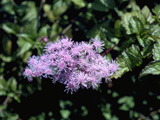
Conoclinium coelestinum (blue mistflower) - perennial to 3 ft., blooms blue, purple July to November, sun, part shade
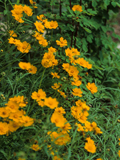
Coreopsis lanceolata (lanceleaf tickseed) - perennial to 1 ft. tall, blooms yellow April to June,
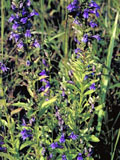
Lobelia siphilitica (great blue lobelia) - perenial, 2 to 3 ft., blooms blue July to October, sun to shade
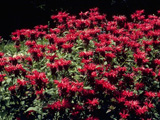
Monarda didyma (scarlet beebalm) - perennial, 3 ft., blooms red May to October, sun, pat shade
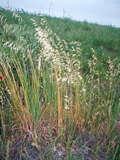
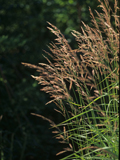
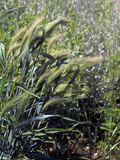
Grasses
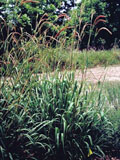
Andropogon gerardii (big bluestem) - warn season perennial, 4 to 8 ft. tall, sun, part shade
Bouteloua curtipendula (sideoats grama) - warm season perennial, 1 to 3 ft., sun, part shade
Bouteloua gracilis (blue grama) - perennial, 1 to 3 ft., sun
Calamagrostis canadensis (bluejoint) - perennial, 3 to 5 ft, sun to shade
Elymus canadensis (Canada wildrye) - cool season perennial, deciduous, 3 to 6 ft., sun, part shade
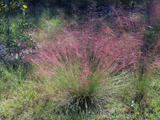
Muhlenbergia capillaris (hairawn muhly) - perennial, 1 to 3 ft., sun
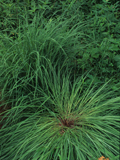
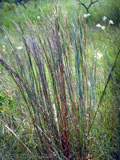
Schizachyrium scoparium (little bluestem) - perennial, 18 to 24 inches, sun, part shade
Tripsacum dactyloides (eastern gamagrass) - perennial, 3 to 6 ft. part shade


More Grasses or Grass-like Questions
Grasses for area under pecan tree in Tennessee
March 26, 2009 - I have two big pecan trees in my yard and would like to know what kind of grasses would thrive in the shade and also survive for my area of the country.
view the full question and answer
Need information about grasses for cattle grazing in Weatherford, TX.
September 16, 2012 - Need info on what I can plant for cattle to graze thru winter. grasshoppers and drought have decimated
our coastal hay for past 2 yrs.Is there anything we can treat all the weeds with besides chemic...
view the full question and answer
Ground cover to withstand dog traffic in Michigan
November 02, 2010 - I need a soft ground cover that will grow in sand, and be able to take four big dogs that love to run in the yard. Grass just doesn't make it. Someone suggested that groundcover might work.
Thanks...
view the full question and answer
Planting Habiturf in an occasional overflow area
November 14, 2014 - Wondering about putting Habiturf in an area that is for occasional flood overflow. How will the Habiturf be affected by these occasional conditions? I suspect it won't like it and will start to thin ...
view the full question and answer
Brown spots in St. Augustine grass
July 05, 2008 - Mr. Smarty Plants, My husband and I are in the Air Force and were recently moved to Cibolo Texas. We built a home and hired a landscaper to finish the yard May 07 (with irrigation system). We laid d...
view the full question and answer
| Support the Wildflower Center by Donating Online or Becoming a Member today. |