Native Plants
Q. Who is Mr. Smarty Plants?
A: There are those who suspect Wildflower Center volunteers are the culpable and capable culprits. Yet, others think staff members play some, albeit small, role. You can torture us with your plant questions, but we will never reveal the Green Guru's secret identity.
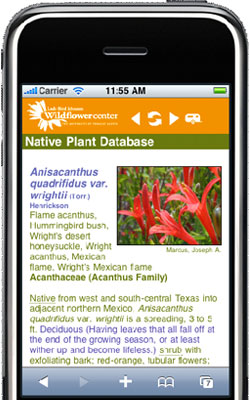
Did you know you can access the Native Plant Information Network with your web-enabled smartphone?

Ask Mr. Smarty Plants
Ask Mr. Smarty Plants is a free service provided by the staff and volunteers at the Lady Bird Johnson Wildflower Center.

rate this answer

Sunday - March 29, 2009
From: Boston, MA
Region: Northeast
Topic: Wildflowers
Title: Parasitic paintbrush
Answered by: Joe Marcus and Damon Waitt
QUESTION:
Many years ago I tried to grow some paintbrush seedlings with some seeds you sent me and found it difficult. Based on pictures in the literature I noticed that paintbrushes do not seem to affect their hosts as drastically as other parasites. Lupines and paintbrushes look well together. From your experience is this correct?ANSWER:
Parasitic plants come in several flavors. Among them, there are obligate parasites, which must parasitize a host plant in order to survive and receives all of its nourishment from the host plant. These plants typically lack chlorophyll. There are facultative parasites which will opportunistically parasitize a host plant given a chance, but can survive and complete its life-cycle without a host. These plants are often called hemiparasites or hemiparasitic plants.Castilleja indivisa (entireleaf Indian paintbrush) is typical of this group of plants. It can and will parasitize neighboring plants via root connections if living in close proximity, but will also grow and reproduce on its own if no host plant is available. The various species of Indian Paintbrush native to Texas often parasitize plants of the grass family (Poaceae), but they really aren't particularly picky about who their hosts are and will attach themselves to and draw nutrients from any number of plant species. Indian Paintbrushes growing with the assistance of a host plant will almost invariably outgrow a sibling without such benefits. Likewise, a host plant parasitized by a Castilleja will normally suffer quite noticably.
... and, yes, lupines and paintbrushes look terrific together.
More Wildflowers Questions
Drought and pollution resistant flowers for Rock Falls, IL
February 08, 2009 - I am looking for hearty flowers for our city planters that are both resistant to drought and auto emissions. We are located in northern Illinois. Planting is done in May.
view the full question and answer
Locales for photographing wildflowers in Dallas, TX area
April 17, 2007 - My daughter has a project for school where she has to find and take her picture with 20 different Texas wildflowers and identify them. We have found some of the more common ones, but I was wondering ...
view the full question and answer
Identification of Texas bluebell (Eustoma exaltatum)
June 27, 2006 - Very recently on the 6 o'clock news there was a report about The Center joining UT. There was a picture of a large, purple lily-like/trumpet flower with a yellow pistil.
I recall my Grandmother call...
view the full question and answer
Butterflies attracted by Pink Evening Primrose from Burnet TX
July 30, 2012 - I see information on Pink Evening Primrose that says it attracts 'many butterflies'
Please tell me which butterflies and name them? I've looked everywhere and am just exhausted and frustrated with...
view the full question and answer
Wildflower meadow in Mobile, AL
January 31, 2009 - I live in Mobile, Alabama. I have 1 acre of land that is partially shaded and covered with centipede yard grass. I would like to completely get rid of all the grass and replace the whole acre with wil...
view the full question and answer
| Support the Wildflower Center by Donating Online or Becoming a Member today. |