Native Plants

Q. Who is Mr. Smarty Plants?
A: There are those who suspect Wildflower Center volunteers are the culpable and capable culprits. Yet, others think staff members play some, albeit small, role. You can torture us with your plant questions, but we will never reveal the Green Guru's secret identity.

Did you know you can access the Native Plant Information Network with your web-enabled smartphone?

Ask Mr. Smarty Plants
Ask Mr. Smarty Plants is a free service provided by the staff and volunteers at the Lady Bird Johnson Wildflower Center.

rate this answer

Wednesday - February 04, 2009
From: Lexington, KY
Region: Mid-Atlantic
Topic: Rare or Endangered Plants, Pruning, Trees
Title: Storm damage to native sweet bay magnolias in Kentucky
Answered by: Barbara Medford
QUESTION:
Can you please share information on storm damage to sweet bay magnolias; if the top is broken off can the tree maintain its natural shape or will the sides begin to grow more than the top; i.e., growth hormones, etc.ANSWER:
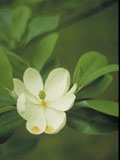
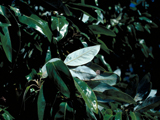
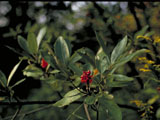
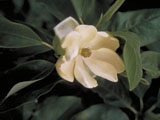
Magnolia virginiana (sweetbay) is a wetlands tree, usually only about 20 feet tall, although it can grow taller and be evergreen in its more southern habitat. Our Native Plant Database does not show it as native to Kentucky, and the USDA Plants Profile does not show it growing in Kentucky, but that is often out of date and inaccurate.
That having been said, we're not sure we understand your question about growth hormones. Were you referring to natural hormones that the tree might have to repair its own damage, or to hormones applied to the tree in some way? Apparently, this is one of the trees that suffered the most damage in the 2004 hurricanes in Florida. It seemed to be snapped off and have large limbs broken off much more frequently than any other native tree species. Are you referring to recent damage? We found out from our own webpage on this tree that it should be pruned after blooming and during growing season because dormant magnolias do not easily heal. Beyond that, we could not learn anything about the possibility of the tree returning to some natural shape after storm damage. This is a lovely, valuable tree and is considered Threatened or Endangered in at least four states, so it is well worth the effort to preserve it.
From this distance, we have no way to determine whether dead limbs should be pruned off now, or some attempt be made at pruning to restore a more natural shape. We would suggest you consult a licensed arborist who can look at the tree and make a diagnosis and recommend solutions. Also, the University of Kentucky College of Agriculture has a Home and Garden site that should lead you to someone who might have information you need.
More Rare or Endangered Plants Questions
SITES (or CITES) accredited source for native orchids
January 03, 2012 - Do you know of a nursery which is SITES accredited which offer North American native orchids? I grow as a hobby indoor ones as well as keep my eyes out protecting the outside native ones we have: Spir...
view the full question and answer
Obtaining invasive weeds for biocontrol research in Florida
July 07, 2005 - I work at the Dept. of Entomology at the University of Florida doing host range testing for biocontrol agents (insects) of invasive weeds in Florida. I need some help in getting live plants of some e...
view the full question and answer
Conservation status of Lathyrus venosus (Veiny pea)
May 30, 2009 - The Wild Pea (Lathyrus Venosus Muhl)
1) What's being done to preserve them
2) When were they placed on the endangered species list
3) How many are left
view the full question and answer
Endangered species of trillium on disturbed soil in New York
April 19, 2006 - Hello, I live in Rochester New York, near a gully/ravine by woodland. Quite a gem. Anyway here's my question and concern. In the past 35 years there have been trillium in small "pockets" or sing...
view the full question and answer
Corrells false dragonhead
September 02, 2007 - I live in South Louisiana. I saw in a recent local paper a picture of Correll's false dragonhead and the small caption under the picture states that this flower is rare and hard to find. I took some...
view the full question and answer
| Support the Wildflower Center by Donating Online or Becoming a Member today. |