Native Plants
Q. Who is Mr. Smarty Plants?
A: There are those who suspect Wildflower Center volunteers are the culpable and capable culprits. Yet, others think staff members play some, albeit small, role. You can torture us with your plant questions, but we will never reveal the Green Guru's secret identity.
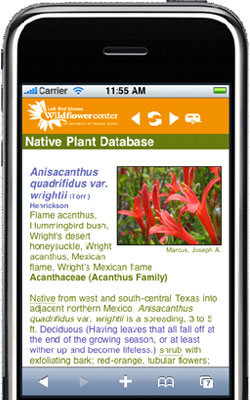
Did you know you can access the Native Plant Information Network with your web-enabled smartphone?
Ask Mr. Smarty Plants
Ask Mr. Smarty Plants is a free service provided by the staff and volunteers at the Lady Bird Johnson Wildflower Center.

rate this answer

Monday - January 19, 2009
From: Indianapolis, IN
Region: Midwest
Topic: Herbs/Forbs, Shrubs, Trees
Title: Floristic Quality Assessment program in Texas?
Answered by: Barbara Medford
QUESTION:
Do you have knowledge of a Floristic Quality Assessment program for Texas such as the ones used in Indiana and Illinois?ANSWER:
The simple answer to your question is, to our knowledge, no program by that name is in existence in Texas. In fact, we had never heard of such a program, and had to do some research. On a Fort Hays State University, Hays, Kansas website Coefficients of Conservatism and Floristic Quality Assessments, we learned that this method was first developed by Floyd Swink and Gerald Wilhelm in 1994. "This method assigns a Coefficient of Conservatism to each native plant species based on that species' tolerance for disturbance and fidelity to a particular pre-settlement plant community type." Looking further, it appears that there are programs by that name either finished or in progress in North and South Dakota, Ohio, Indiana, Virginia, Wisconsin, Illinois and some foreign countries, including Tuscany in Italy.
The mission of the Lady Bird Johnson Wildflower Center is to increase the sustainable use and conservation of native wildflowers, plants and landscapes. On our website, you can read about programs we are sponsoring or in which we are participating, including Land Restoration, Seed Banks, Invasive Plants, Sustainable Sites, and the Carbon Footprint. In addition, anyone interested in doing so can research specific plants by visiting our Native Plant Database, on which, at present, there are 7009 plants listed that are natives of North America, not including Mexico. Our Image Gallery has, right this minute, 23,528 images of native plants. Both the Gallery and the Database are being constantly updated. There is a Bibliography listing many hundreds of books on the subjects of native plants and conservation. Also on our website is a National Organizations Directory, through which organizations working on the same goals can be contacted. Someone searching for appropriate native plants for their own gardens can find plants native to their area by going to Recommended Species, and asking for specific habits (tree, shrub, grass, etc.) and get a list of the best choices.
In point of fact, not to toot our own horn too much, it would appear that we at the Lady Bird Johnson Wildflower Center have the same concerns and are going in the same direction as those conducting the Floristic Quality Assessment programs.
More Trees Questions
Trees native to Long Island, NY
November 06, 2010 - My question is: What are the main trees that were native to Long Island before all other trees began to be brought into Long Island?
view the full question and answer
Fertilizing oaks to produce acorns
January 16, 2012 - Will fertilizing oak trees help with acorn production?
view the full question and answer
Growing non-native grapefruit from seeds from Austin
April 30, 2013 - Can you grow ruby red grapefruit trees from seeds?
view the full question and answer
Identification of tree or shrub in Massachusetts
May 16, 2013 - Good morning,
We are in Zone 5 and have a tree/shrub I cannot identify in the backyard of our new home. Tall (6')and growing, green stems,and when the stems are broken the branches smell of lemon o...
view the full question and answer
Problems with tuliptree in North Salem IN
September 02, 2009 - I have a tulip tree and it looks like it is dying. The limbs are starting to turn bright blue. Do I have an insect problem or is it from a lightning strike?
view the full question and answer
| Support the Wildflower Center by Donating Online or Becoming a Member today. |