Native Plants

Q. Who is Mr. Smarty Plants?
A: There are those who suspect Wildflower Center volunteers are the culpable and capable culprits. Yet, others think staff members play some, albeit small, role. You can torture us with your plant questions, but we will never reveal the Green Guru's secret identity.
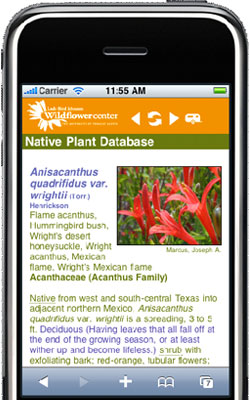
Did you know you can access the Native Plant Information Network with your web-enabled smartphone?

Ask Mr. Smarty Plants
Ask Mr. Smarty Plants is a free service provided by the staff and volunteers at the Lady Bird Johnson Wildflower Center.

rate this answer

Friday - July 04, 2008
From: Grand Prairie, TX
Region: Southwest
Topic: Invasive Plants
Title: Controlling Phragmites australis, common reed
Answered by: Nan Hampton
QUESTION:
Dear Mr. Smarty Plants, I volunteer at Cedar Ridge Preserve in Dallas. We are currently chopping down an invasive called Phragmites australis around the pond. The belief is that by continuously chopping down the plant will stress it and kill it. Do you know of a better way? Thank you.ANSWER:
The Nature Conservancy reports the successful control of Phragmites australis (common reed) in Kampoosa Bog, Massachusetts by cutting the reeds and then judiciously applying herbicide down the cut stumps of the reed with squirt bottles. This contained the herbicide within the target plant so that it didn't affect other plants nearby. You can read more descriptions of control methods used by the Nature Conservancy in "Control Comments from Stewards" and in "Element Stewardship Abstract for Phragmites australis".
More Invasive Plants Questions
Control methods for Cenchrus spinifex, Coastal sandbur
September 22, 2006 - I have some of the nicest, thickest, greenest grassburs in the county of Erath. What is the best and quickest way to get rid of them? I have heard of a product called cornmeal gluten. Any info appreci...
view the full question and answer
A&M maroon bluebonnets for Hawaii
July 10, 2011 - My daughter graduated from Texas A&M and has moved to Hawaii. She would love to have the maroon bluebonnets developed by A&M to plant in her new home. How would she need to prepare the seeds since t...
view the full question and answer
Invasives species experiment from Fairfax VA
May 09, 2013 - Dear Mr. Smarty Plants,
I have some friends that need an experiment on Invasive Species fast. They are in 11th grade at Robinson secondary school. Are you able to help? Its due in June and they don'...
view the full question and answer
Elimination of nutgrass from native flower bed
October 14, 2007 - Nutgrass!*#!* My new bed in NE Austin wraps around a hot sunny SW street corner. Grass wouldn't grow there [I wouldn't water it.] I removed the turf [mostly stickers] to a depth of about 4", carefu...
view the full question and answer
Removing St. Augustine, replacing with native plants
October 06, 2007 - Hello Mr. Smarty Plants, always excited to talk to the Green Guru himself. I've recently purchased a house in South Austin and am interested in establishing a small, 500+ sq ft, prairie grass and wi...
view the full question and answer
| Support the Wildflower Center by Donating Online or Becoming a Member today. |