Native Plants
Q. Who is Mr. Smarty Plants?
A: There are those who suspect Wildflower Center volunteers are the culpable and capable culprits. Yet, others think staff members play some, albeit small, role. You can torture us with your plant questions, but we will never reveal the Green Guru's secret identity.
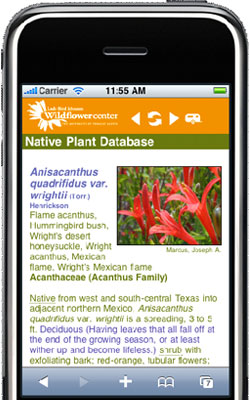
Did you know you can access the Native Plant Information Network with your web-enabled smartphone?

Ask Mr. Smarty Plants
Ask Mr. Smarty Plants is a free service provided by the staff and volunteers at the Lady Bird Johnson Wildflower Center.

rate this answer

Monday - June 02, 2008
From: New Britain, CT
Region: Northeast
Topic: Planting, Shrubs
Title: Non-blooming rhododendron in Connecticut
Answered by: Barbara Medford
QUESTION:
A two or three yr old rhododendron has not blossomed - ever! All other plants in landscape doing well, but not this one. HelpANSWER:
Rhododendron is a large Genus with over 1000 species, including plants known to gardeners as azaleas. Rhododendrons are very widely distributed occurring through most of the Northern Hemisphere except for dry areas, extending into the Southern Hemisphere through Indo-China, Korea and Japan. Tropical rhododendrons occur from southeast Asia to northern Australia, as well as Borneo and New Guinea. This plant has been extensively hybridized, and tracing its parentage could be very difficult. However, most rhododendrons and azaleas are at their best in fairly mild, humid climates. See this University of Missouri Extension Growing Azaleas and Rhododendrons for more information.
Rhododendrons are grown commercially in many areas for sale, and are occasionally collected in the wild, a practice now rare in most areas. Larger commercial growers often ship long distances; in North America, most of them are located on the west coast, Oregon, Washington and California. Large-scale commercial growers often select for different characteristics than home gardeners might want, such as resistance to root rot when over-watered, ability to be forced into budding early, ease of rooting or other propagation, and saleability. So, you're gardening in Connecticut and getting plants from your nursery that may be non-native in origin and grown on the West Coast in mild, humid areas. We don't think that means your plant is never going to bloom, we just think it might not be mature enough, yet. You do need to check that your plant is in an acid soil, well-drained and high in organic matter. Generally, these are considered understory, part shade plants, but they do need a certain amount of sun to bloom well, so if it's too dark where your rhododendron is, that might be the problem. If you decide that your plant is simply in the wrong place, they have fibrous, shallow roots and transplant well, but it would be better to wait until early Fall when the plant will be more dormant.
More Planting Questions
Need plants for new wrought iron planter in Spicewood,TX.
April 10, 2012 - I live in Spicewood, Texas, and have just purchased some really nice wrought iron window boxes for my patio railing. What would be the best and prettiest plants to use? Thank you
view the full question and answer
Planting bluebonnets on UT Campus in Austin
January 07, 2012 - Hello!
I am with a student organization on the University of Texas campus. Walking around campus, I have noticed the lack of the state flower of Texas, the bluebonnet. Our organization is hoping ...
view the full question and answer
Cenizo as a Foundation Plant in Austin
December 09, 2010 - We live next to the wildflower center. We would like to plant "Leucophyllum frutescens". We are hoping to use this as a foundation plant.
Will it survive if planted in Dec. Please offer any tips ...
view the full question and answer
Removal of honeysuckle bushes from Coaldale Alberta Canada
July 30, 2010 - I have 2 honeysuckle bushes that I want to get rid of. I am wondering if Honeysuckle bushes have very deep roots (are they hard to dig out?) I am 70 years old and didn't know if I'd be able to dig ...
view the full question and answer
Planting Texas Mountain Laurel seeds in Horse Shoe Bay,TX
July 09, 2012 - I have harvested Texas Mountain Laurel pods and extracted the seeds from the pods. The seeds are characteristic red/orange/maroon. When is the best time and best method to introduce seeds into pots? ...
view the full question and answer
| Support the Wildflower Center by Donating Online or Becoming a Member today. |