Native Plants
Q. Who is Mr. Smarty Plants?
A: There are those who suspect Wildflower Center volunteers are the culpable and capable culprits. Yet, others think staff members play some, albeit small, role. You can torture us with your plant questions, but we will never reveal the Green Guru's secret identity.
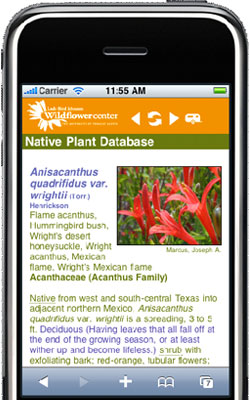
Did you know you can access the Native Plant Information Network with your web-enabled smartphone?

Ask Mr. Smarty Plants
Ask Mr. Smarty Plants is a free service provided by the staff and volunteers at the Lady Bird Johnson Wildflower Center.

rate this answer

Saturday - April 19, 2008
From: Meridian, ID
Region: Rocky Mountain
Topic: Non-Natives
Title: Tentative identification of non-native Senecio rowleyanus
Answered by: Barbara Medford
QUESTION:
I am trying to track down a plant that I used to have but do not know what it is called. It grew in long strings of "pea like" balls. When planted in a hanging pot, the stringy "pea" like vines looked really cool and I would like to have one again. The one I used to have was picked clean by my then 1 year old child.ANSWER:
This sounds very like a succulent that we have seen from time to time without knowing what it was. So, we went looking at succulents, and have found one that appears to match your description. Here is a page of images of Senecio rowleyanus; see if it matches your memory of the plant. Somewhat to our surprise, it is a member of the family Asteraceae, but when you see pictures of the flowers, you will see that they lack the ray-like florets that ordinarily appear in that family. It is sometimes called "string of beads" or "string of peas", and the round "beads" are actually leaves, adapted to conserve moisture during extreme periods of drouth. It is native to southwest Africa, and therefore a little out of the area of expertise of the Lady Bird Johnson Wildflower Center, which is dedicated to the care and propagation of plants native to North America. However, many indoor container plants are non-native subtropicals, which can adapt to the conditions of indoor living. Go to this website Plants to Grow to learn about its care and culture. Many nurseries carry a selection of succulents, or possibly you could order it by mail. Hope we found the right plant!
More Non-Natives Questions
Regulations for transporting plants to Texas from Florida
July 29, 2008 - We are relocating to TX from FL, I have a collection of potted palm trees and quite a few potted tropical plants (none are invasive)that I would like to bring with us, we will be traveling by car and ...
view the full question and answer
Mexican feathergrass from Pflugerville, TX
January 23, 2013 - How deep are the roots of Nassella tenuissima? I'm looking for something that could possibly discourage my neighbors' bermuda grass from encroaching into my native plantings.
view the full question and answer
Transplanting bamboo
July 29, 2008 - To transplant bamboo from one place to another, do you dig the plant up or do you get a cutting, put it in water and then root the plant?
view the full question and answer
Identity of mystery plant in non-native commercial forage mix
December 17, 2013 - Dear Smart One,
I use a commercially prepared, fortified, chopped forage based on a mix of orchard and Timothy grasses. The bags are shipped in from out of State. However, I have been finding short s...
view the full question and answer
Dietes bicolor invasive from Brisbane Australia
April 01, 2013 - We have dietes bicolor growing in our garden. I am changing the type of garden and cannot seem to kill it. I've dugged it out, spent too many weekends pulling out every new shoot, used poison, but t...
view the full question and answer
| Support the Wildflower Center by Donating Online or Becoming a Member today. |