Native Plants

Q. Who is Mr. Smarty Plants?
A: There are those who suspect Wildflower Center volunteers are the culpable and capable culprits. Yet, others think staff members play some, albeit small, role. You can torture us with your plant questions, but we will never reveal the Green Guru's secret identity.

Did you know you can access the Native Plant Information Network with your web-enabled smartphone?

Ask Mr. Smarty Plants
Ask Mr. Smarty Plants is a free service provided by the staff and volunteers at the Lady Bird Johnson Wildflower Center.

rate this answer

Wednesday - November 14, 2007
From: Lexington, MA
Region: Northeast
Topic: Vines
Title: How to get rid of invasive vine
Answered by: Nan Hampton
QUESTION:
We moved into our very old (300+ year house) several years ago and I am slowly getting round to cleaning up and replanting flower beds. When I cleared the space to grow clematis along a fence in the back yard, my plants were soon taken over by what looked like wisteria vines (7-9 long pointed leaves opposite each other with 1 leaf at the end) growing from 1-2 inch seedpods. The flowers were an unattractive yellow-brown-a little reminiscent of snapdragons. What do I have and how can I get rid of it? There are vestiges of very old, very thick, dead wisteria trunks in the front of the house but no evidence of any in the back.ANSWER:
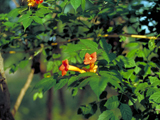
The closest match Mr. Smarty Plants can come up with is Campsis radicans (trumpet creeper). Although your description of the flower doesn't really match, the leaf shape does and this plant can be very aggressive. The flowers can be red, yellow or some blend of the two colors. If you would like a more certain identification of your vine and you have photos of it and its flowers, you can send them to us. Please see the lower right corner of the Mr. Smarty Plants page for instructions on submitting photos.For the purpose of getting rid of this unwanted vine, it really doesn't matter too much what its identity is. The foolproof way of doing so is to dig up the roots. I know that's probably not what you wanted to hear, but, alas, that is the most reliable (plus the most environmentally-friendly way) to accomplish the desired results. Dig out as much of the roots as you can and in the spring watch for and destroy any new growth that occurs.
More Vines Questions
Identity of vining plants in yard in Texas
May 08, 2015 - I have vining plants in my back-yard, here when I bought the house, that, from what I have been able to find on-line, look like poison sumac, however, I know they are not. Leaf shape, color, and appe...
view the full question and answer
Identification of Matelea reticulata
June 08, 2007 - I recently saw blooming in an Austin park a small white-green flower ( 3/4 ") with a center that looked like a small pearl. Any idea what it is. I can't find it in my flower book, It was on a waist...
view the full question and answer
Finicky Trumpet Vine in Stockdale Texas
June 06, 2011 - I need help dealing with a very old trumpet vine. It was my grandmothers and she died in 79. It's always been beautiful till 99 when my grandmothers house burned down. It was right behind it. It cam...
view the full question and answer
Evergreen vine for trellis in Fredricksburg, Texas
March 27, 2011 - Hello, and thank you so much for this service. I am looking for a non-deciduous vine to plant on the east side of my house. I have already put in a trellis, now I need to know what to plant on it. ...
view the full question and answer
Vine for privacy on a deck in Southern California
December 10, 2009 - I am looking for a climbing vine/plant that is non-flowering and can be grown year round in Southern California. We are looking to help create a private area along a deck for my grandmother because h...
view the full question and answer
| Support the Wildflower Center by Donating Online or Becoming a Member today. |