Native Plants

Q. Who is Mr. Smarty Plants?
A: There are those who suspect Wildflower Center volunteers are the culpable and capable culprits. Yet, others think staff members play some, albeit small, role. You can torture us with your plant questions, but we will never reveal the Green Guru's secret identity.
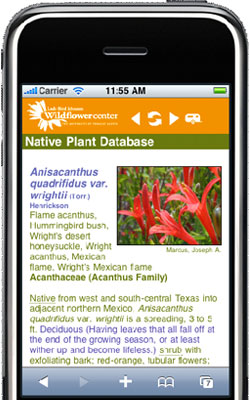
Did you know you can access the Native Plant Information Network with your web-enabled smartphone?

Ask Mr. Smarty Plants
Ask Mr. Smarty Plants is a free service provided by the staff and volunteers at the Lady Bird Johnson Wildflower Center.

rate this answer

Friday - November 02, 2007
From: Austin, TX
Region: Southwest
Topic: Planting, Seasonal Tasks, Transplants, Herbs/Forbs, Trees
Title: Optimum planting time for perennials and trees
Answered by: Barbara Medford
QUESTION:
Our group is running out of fall workdays. Is it OK to plant native perennials and small trees in Central Texas during the winter months? Or should we wait now until the spring?ANSWER:
November, December and January have always been our favorite time to plants woody plants. If you already have them, then certainly the sooner you get them in the ground, the better. You don't want the roots to dry out, and you sure don't want them out of the ground when the first freeze comes. The ground is a great insulator, and will keep the new roots from being damaged. You should try very hard to avoid transplant shock-in other words, get water in the loose soil around the roots, at a small dribble from a hose, about 3 times a week. The average first frost in Austin is usually about December 1, but in this temperate region, the ground does not freeze, and frosts usually last only a few hours. While the plants are in dormancy during cooler weather, the moisture in the plant is down around the base and in the roots. A plant can be severely damaged or killed by a heavy, hard frost freezing the water in the plant. The cell walls can burst when the water expands as it freezes, and the damage can be fatal. Another protection for the newly planted trees and perennials is a good, thick coat of an organic mulch over their root systems. This will hold moisture in the soil, further insulate the roots, and as it decomposes, add still more warmth and help to enrich the soil.
If the plants are being held in plastic pots and a freeze is predicted, a friendly garage, if one is available, would be a good place to store them. Plastic is no insulator, and can get very cold and very hot, to match the outside temperature. And if you are holding plants in pots, be sure to keep them watered. Even in dormancy, some moisture is needed, and a plant without its roots in the earth is very susceptible to drying out.
To sum up, a plant waiting to be transplanted into a permanent position, and with its roots out of the ground, is better off being planted just about any time, but the best time is when it's cool and the plants are in dormancy.
More Transplants Questions
Carolina Jasmine failing to turn green in Pleasant Garden NC
April 26, 2011 - We planted Carolina Jasmine last year and it did great. This Spring we only have about 2-3 small green leaves beginning on the vines. We did not cut them back in the Fall. Is it time for them to be tu...
view the full question and answer
Will a Texas Mountain Laurel thrive in a 4'x4'x4' brick planter. pl
September 14, 2015 - Would a Texas Mountain Laurel thrive in a 4'x4'x4'x4' brick planter with a drain at the bottom? It will get full sun all day. If not, would a Green Cloud Sage or a Waxleaf Myrtle work? Thanks!
view the full question and answer
Promote blooms on non-native plants
June 11, 2008 - I am trying to promote blooms on my several types of flowering scrubs and ornamentals, but not having much luck. I have used Miracid SuperBloom occasionally but not sure I am using enough, yet I may ...
view the full question and answer
Replanting of non-native Christmas Palm from Sarasota FL
November 28, 2012 - Do you know of a proven technique to plant a Christmas Palm in a built-in concrete pool deck planter box - using gravel around the soil root ball to delay the root bound condition we just ripped out?
view the full question and answer
Transplanting a magnolia tree in Avon IN
July 04, 2009 - We moved in our house a couple of years ago,We have a small Magnolia tree, well, looks like a bush right in front of our porch. We want to move it but do not know the best time to move. Can you tell m...
view the full question and answer
| Support the Wildflower Center by Donating Online or Becoming a Member today. |