Native Plants

Q. Who is Mr. Smarty Plants?
A: There are those who suspect Wildflower Center volunteers are the culpable and capable culprits. Yet, others think staff members play some, albeit small, role. You can torture us with your plant questions, but we will never reveal the Green Guru's secret identity.

Did you know you can access the Native Plant Information Network with your web-enabled smartphone?

Ask Mr. Smarty Plants
Ask Mr. Smarty Plants is a free service provided by the staff and volunteers at the Lady Bird Johnson Wildflower Center.

rate this answer

Tuesday - August 21, 2007
From: Leander, TX
Region: Southwest
Topic: Shrubs
Title: Identification of eleagnus-like shrub
Answered by: Nan Hampton and Joe Marcus
QUESTION:
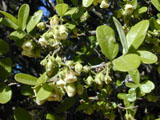
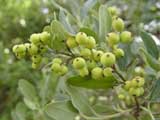
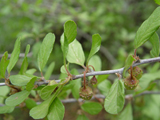
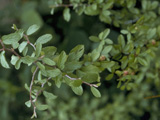
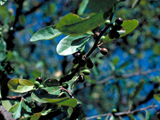
There is a plant on our land I can't identify. It has a tree-like smooth light gray "trunk", with leaves similar to an eleagnus (grayish green and rough on top, lighter underneath). I can't find a "grown-up" version of this, so I don't know if it's a shrub, small tree, or just a woody plant. My mom said it has white little flowers, and black berries. The berries come from the end of the leaf stem, not underneath (I think--it's been awhile since I've seen the berries--maybe Feb or March). Suggestions? Pictures of said suggestions? It's not a Madrone, the leaves are too fat. Thanks for any and all help?ANSWER:
Here are a few possibilities that Mr. Smarty Plants found that have at least some of the characteristics you describe:Diospyros texana (Texas persimmon)
Forestiera pubescens (elbowbush or stretchberry)
Garrya ovata ssp. lindheimeri (Lindheimer's silktassel)
Condalia hookeri (Brazilian bluewood)
Colubrina texensis (Texan hogplum)
Sideroxylon lanuginosum ssp. lanuginosum (gum bully)
If you don't think that one of these is your plant, please send us photographs and we will do our best to identify it. Here are instructions for submitting photographs for identification:
1. Tell us where and when you found the plant and describe the site where it occurred.
2. Take several images including details of leaves, stems, flowers, fruit, and the overall plant.
3. Save images in JPEG format, not more than 640 x 480 pixels in size, with resolution set at 300 pixels per inch.
4. Send email with images attached to [email protected]. Put Plant Identification Request in the subject line of your email.
You can also see these instructions on the Ask Mr. Smarty Plants page in the lower righthand corner.

More Shrubs Questions
Spots on calycanthus petals from Buckley WA
June 20, 2013 - Petals on calycanthus develop black spots the turn into holes. Problem appears shortly after buds open. Occurs every year. Foliage is healthy. Plant growing well and doubles or triples size every ...
view the full question and answer
Can rose Zephirine Drouhin damage brick from Springfield IL
August 22, 2010 - Can ZÉPHIRINE DROUHIN damage brick?
view the full question and answer
Landscaping for a wedding in Memphis MO
October 13, 2009 - I am pretty new at this landscaping flower thing, but I love it. We just moved out to the country in NE Missouri from Colorado (Huge difference, but love it). We have decided to have our wedding at o...
view the full question and answer
Dwarf evergreen shrub for windowboxes in Staten Island , NY
April 03, 2008 - Dear Mr. Smarty Plants,
Could you recommend a dwarf evergreen shrub, not deciduous that also has pretty flowers that would thrive in a container in the northeast...area would have sun for about 4 -5...
view the full question and answer
mixed species privacy hedge in Central Texas
March 24, 2016 - I need to plant a privacy hedge along a fence line. I am in east Austin, blackland prairie soil. The soil is rich, usually at least moist but not soggy, and I find lots of worms when I dig. The fen...
view the full question and answer
| Support the Wildflower Center by Donating Online or Becoming a Member today. |