Native Plants

Q. Who is Mr. Smarty Plants?
A: There are those who suspect Wildflower Center volunteers are the culpable and capable culprits. Yet, others think staff members play some, albeit small, role. You can torture us with your plant questions, but we will never reveal the Green Guru's secret identity.

Did you know you can access the Native Plant Information Network with your web-enabled smartphone?

Ask Mr. Smarty Plants
Ask Mr. Smarty Plants is a free service provided by the staff and volunteers at the Lady Bird Johnson Wildflower Center.

rate this answer

Monday - July 30, 2007
From: Pittsburgh, PA
Region: Northeast
Topic: Diseases and Disorders, Shrubs
Title: Protection of American beautyberry in Pennsylvania
Answered by: Barbara Medford
QUESTION:
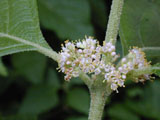
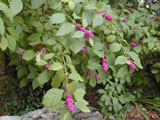
I have had a beauty berry 2 years now. I trim it back in early spring and it returns beautifully. ...but no flowers this year and it's almost August. Last year, very few berries. Can you help? It is in a fairly sunny spot. I am in Pittsburgh.ANSWER:
Callicarpa americana (American beautyberry) is a native much loved by birds and gardeners for its lush berries and ability to do well in shade or partial shade. American beautyberry occurs naturally from Maryland south and southwest to Texas. In Pennsylvania you are in Zone 5 and probably need to protect your beautyberries with a thicker mulch in the winter, depending on your location and elevation. The American beautyberry grows naturally on the forest floor, and one source said it helps to replicate the conditions of filtered sun, rich organic soil and lots of water. The beautyberry will sometimes fail to fruit or drop leaves during drought periods. Pruning in late winter seems to be okay, and should encourage lusher growth and more flowers and berries.
So, having tried to establish what care is good for your plants, we still are not sure what is causing the sparseness of flowers and berries. While American beautyberry is a shade-loving plant, it flowers better if it receives at least some sun each day. In heavy shade it is not likely to set fruit well. Since yours in in a sunny spot, that is not likely the problem. You say you have had the beautyberry two years. Is it possible that it has not matured enough yet to produce the kind of flowers and berries you are expecting? We at the Lady Bird Johnson Wildflower Center applaud your practice of growing native plants and suggest that with a few alterations in the way you care for them and perhaps a little patience, your young plant will grow up to be large and lovely.

More Diseases and Disorders Questions
Prickly pear doing poorly on Long Island NY
December 27, 2012 - First, thanks for your reply on 11-3-12, re.Can a prickly pear cutting from Harker Heights, TX find happiness in Long Island, NY. The plants were set before a southern window in the attic, temp. ra...
view the full question and answer
Problems with gaura in Kyle TX
May 10, 2011 - Gaura - I seem to have something going on with this plant. I've tried fungicide that also works on mealy bugs and spider mites, etc., but they're looking rather puny? Any suggestions? thanks
view the full question and answer
Non-fruiting squash
July 25, 2007 - With all this rain in Dallas why would our Zuchinni and Yellow squash be beautiful and green but not produce any squash?
view the full question and answer
Changing colors on Mexican Plum trees from Bellaire TX
June 20, 2013 - The leaves on my Mexican Plum tree have recently started turning yellow/brown and the veins in leaves are red. Is this a watering issue or disease issue? Mites are on the leaves. This has been a ra...
view the full question and answer
Care of Styphnolobium affine, Eves necklace
October 05, 2007 - I have an 18 yr old Eve's Necklace tree that is dying from the "bottom up". It has only a few leaves at the very top of the tree. I have, connected to the gutter, a rain barrel from which the exc...
view the full question and answer
| Support the Wildflower Center by Donating Online or Becoming a Member today. |