Native Plants
Q. Who is Mr. Smarty Plants?
A: There are those who suspect Wildflower Center volunteers are the culpable and capable culprits. Yet, others think staff members play some, albeit small, role. You can torture us with your plant questions, but we will never reveal the Green Guru's secret identity.
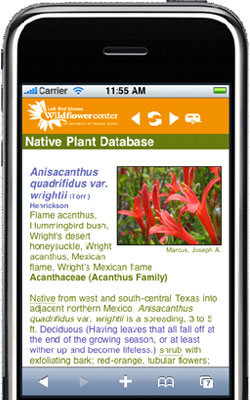
Did you know you can access the Native Plant Information Network with your web-enabled smartphone?
Ask Mr. Smarty Plants
Ask Mr. Smarty Plants is a free service provided by the staff and volunteers at the Lady Bird Johnson Wildflower Center.

rate this answer

Thursday - March 17, 2016
From: Bradenton, FL
Region: Southeast
Topic: Non-Natives
Title: Pachira aquatica loosing leaves.
Answered by: Anne Van Nest
QUESTION:
We have an indoor money tree that is 20 feet tall, the leaves have started to turn brown and fall. We water twice a month and mist about the same. Can you opine what what we are doing wrong the plant has been with us for 6 years and is dear to us?ANSWER:
According to Wikipedia, the Money tree or Guiana chestnut (Pachira aquatica) is a tropical wetland tree in the Malvaceae family and native to Central and South America where it grows in swamps. It is not a native tree and therefore isn't in the Lady Bird Johnson Wildflower Center database. I have seen a Pachira aquatica growing to that size inside the Butterfly Conservatory at the Niagara Parks Botanical Garden in Niagara Falls, Ontario Canada. It is planted in a generous amount of soil and gets the same amount of water as the other tropical plants. The leaves do turn brown on the edges occassionally and the older ones do drop.
If your plant is dropping a lot of leaves perhaps it needs water more frequently than just 2 x a month. Misting twice a month is not very effective and you can discontinue it.
A quick search online resulted in these tips from the www.apartmenttherapy.com website ...
This plant loves moisture but you should never let it stand in water. Good drainage is essential.
• Position this plant in bright indirect light indoors.
• Water this plant consistently. 1 - 2 times per week depending on humidity. Make sure you water all the topsoil, just until the water starts leaking out the drain holes.
• For optimal longevity, lightly fertilize the Pachira 3 - 4 times a year with a water-soluble fertilizer.
More Non-Natives Questions
When will non-native Confederate Jasmine bloom in Austin
March 03, 2014 - I have 2 large Confederate Jasmine plants growing in 3 gallon pots on either side of an arbor I built for my friends wedding. The wedding is in 1 month and I'm wondering if this jasmine typically bl...
view the full question and answer
Identity of mystery plant in non-native commercial forage mix
December 17, 2013 - Dear Smart One,
I use a commercially prepared, fortified, chopped forage based on a mix of orchard and Timothy grasses. The bags are shipped in from out of State. However, I have been finding short s...
view the full question and answer
Changing color of crape myrtle blooms
July 08, 2008 - I have 5 well established crape myrtle trees whose blooms are a very light lavender/pink color. I would like to know if there is any way to deepen or change the color of the blooms. I would prefer a m...
view the full question and answer
Non-native fountain grass for Edwardsburg MI
September 20, 2009 - I purchased a purple fountain grass by a vendor @ the Plymouth, IN blueberry festival. He told me that it is a perennial. I live in Edwardsburg, MI and I keep reading that
in my area, they are consi...
view the full question and answer
Removal of invasive non-native Chinese wisteria
September 10, 2007 - I am going to be removing my ubiquitous chinese wisteria very soon (the method I'm going to use is undetermined). If I decide to use Round-up on the cut-stem (which may take more than one application...
view the full question and answer
| Support the Wildflower Center by Donating Online or Becoming a Member today. |