Native Plants

Q. Who is Mr. Smarty Plants?
A: There are those who suspect Wildflower Center volunteers are the culpable and capable culprits. Yet, others think staff members play some, albeit small, role. You can torture us with your plant questions, but we will never reveal the Green Guru's secret identity.

Did you know you can access the Native Plant Information Network with your web-enabled smartphone?

Ask Mr. Smarty Plants
Ask Mr. Smarty Plants is a free service provided by the staff and volunteers at the Lady Bird Johnson Wildflower Center.

rate this answer

Sunday - July 10, 2016
From: Austin, TX
Region: Southwest
Topic: Plant Laws, Drought Tolerant, Privacy Screening, Shade Tolerant, Shrubs, Trees
Title: Drought Resistant Privacy Screen for North Side of Austin Texas House
Answered by: Anne Van Nest
QUESTION:
We live in the densely populated Mueller development, where there's barely 3 feet from our home to the 6 foot high privacy fence between us and the house next door. Since the houses are 2 stories, we need to add a high privacy screen, one reaching at least 8-10 feet on both the north and south sides of our home. For the south side we are considering clumping bamboo...but we are at a loss for what to plant on the north side. Given this area was previously an airport, the soil is poor...plus we want something that's reasonably drought tolerant once established. Suggestions please.ANSWER:
Sorry for the delay in answering your question. A look at the Native Plant Database on the www.wildflower.org website did turn up some suggestions for you to consider. The search selected Texas shrub or tree natives that tolerate part shade, dry conditions, is an evergreen and will grow to 12 feet tall. These include:
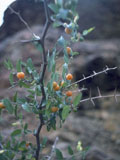
Castela erecta ssp. texana (allthorn goatbush)
A thicket forming, spiny shrub with bitter bark. Found on exposed hillsides and in prairies. Branchlets light colored, terminating in stout spines bearing lateral ones. Leaves firm textured, up to 1 inch long by 1/4 inch wide, with a pointed or rounded tip and smooth, turned down margins, the upper surface shiny, the lower covered with fine hairs visible under a 10x hand lens. Flowers small, red to orange, occurring singly or in small groups. Fruit fleshy, red, roughly spherical, slightly flattened, up to 3/8 inch long. Bark reputed to have medicinal properties. 6-12 feet tall.
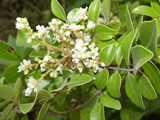
Celtis ehrenbergiana (desert hackberry)
One of the few shrubs in the Celtis genus, this deciduous plant rarely reaches 10 ft. in height. Its numerous spiny branches are whitish gray. The bark is smooth and gray. Leaves are small, roundish, and somewhat rough. Clusters of small, fairly inconspicuous, white flowers are followed by shiny red, orange and yellow fruit ripening in fall but persisting long after leaf-fall.
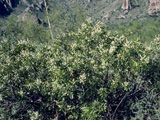
Garrya ovata ssp. lindheimeri (Lindheimer's silktassel)
Evergreen shrub or small tree. Frequent on limestone ledges and rocky slopes of canyons and ravines. Twigs with leaf scars that go completely around them and gray streaks (lenticels) running lengthwise in the reddish brown bark. Leaves opposite, petioled; blade leathery, variable in shape, roughly elliptic, up to 2 1/2 inches long, with a very small, abrupt tip and smooth margins, smooth on the upper surface, velvety on the lower. Flowers about 3/16 inch wide, in simple pendulous clusters from the bases of the leaf petioles, opening in March and April. Fruit fleshy, round, with a short tip, blue with a white coating easily rubbed off, about 3/8 inch in diameter.
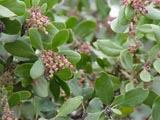
Evergreen sumac is a shrub or small tree, from 8-12 ft. in height with spreading branches. Its shiny, evergreen, pinnate foliage is tinged with pink in early spring and maroon after frost. Leaves are alternate, 2–5 1/2 inches long, with 5–9 fleshy leaflets on stiff stems. The 5-petaled, inconspicuous, greenish or white flowers grow in clusters 1–2 inches long at the end of stout branches. When the fruit matures in mid-September it is red, broader than long, and covered with fine hair.
Evergreen sumac can be used to make a nice, thick hedge or screen, but can grow tree-like with a long, straight trunk. Only female plants produce flowers and berries. It is fast growing, generally insect and disease-free, and drought-tolerant. Not a true evergreen – leaves are green through the winter, then are dropped, to be replaced within a week with a new crop.
Sophora tomentosa (yellow necklacepod)
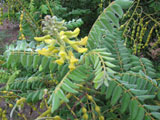
Yellow necklacepod or yellow sophora is an evergreen shrub with a delicate, multi-stemmed shape and chartreuse branches. Silvery-green foliage provides a backdrop for the 4-16 in spikes of yellow flowers. Seedpods hang on the shrub for a year or more. This plant grows 3-6 feet in height.
A native of southern Florida and South Texas, where it is infrequent along and near the coast as far north as Aransas county. Its overall natural range comprises just about every tropical and subtropical coast in the world. This shrub is hardy to about 20 degrees Fahrenheit (often freezes back at our latitude behaving as a subshrub).
From the Image Gallery

More Plant Laws Questions
Critter-Proof Native Plants for Virginia Lawn
April 02, 2015 - We live in a gated community that was part of the Wilderness Battlefield during the Civil War. Our home is on a narrow lot, fully treed except for a postage stamp-sized lawn at lake side. We have de...
view the full question and answer
Companion Plants for Salix nigra in Texas
April 02, 2015 - I'm looking the list of companion plants as well as those that might not go well with Salix nigra.
view the full question and answer
Wildflowers being mowed in Canyon TX
June 03, 2012 - Can I receive a letter from someone there to put up in our neighborhood? I live in an area very close to Palo Duro Canyon. A developer out here mows down the wildflowers along the one lane road. It ...
view the full question and answer
Low, Easy Care Perennials for Lake Ontario Shore Planting
October 04, 2015 - I'm on Lake Ontario in New York. I have a lake bank slope, that’s about 1/8 mile long and about 40 feet high, and is on about a 40 degree angle. It is very hard to keep clear. The bank has just been ...
view the full question and answer
Rescue of roadside plants in Ashe Co.
October 27, 2011 - I live in a wooded area off of a dirt road that is going to be widened and paved by the state. There are many native plants and shrubs growing on the side of the road in areas that will soon be pavem...
view the full question and answer
| Support the Wildflower Center by Donating Online or Becoming a Member today. |