Native Plants

Q. Who is Mr. Smarty Plants?
A: There are those who suspect Wildflower Center volunteers are the culpable and capable culprits. Yet, others think staff members play some, albeit small, role. You can torture us with your plant questions, but we will never reveal the Green Guru's secret identity.

Did you know you can access the Native Plant Information Network with your web-enabled smartphone?

Ask Mr. Smarty Plants
Ask Mr. Smarty Plants is a free service provided by the staff and volunteers at the Lady Bird Johnson Wildflower Center.

rate this answer

Monday - April 20, 2015
From: Brevard, NC
Region: Southeast
Topic: Grasses or Grass-like
Title: Groundcover for Slope in NC under Black Walnut
Answered by: Anne Van Nest
QUESTION:
Please advise on some plants for a difficult to mow 30% slope, near Asheville, NC. We have partial sun, plenty of good rich topsoil, and plenty of rain. The key issue is that it is under and near the drip edge of huge black walnut trees. Our hill currently has successful, established turf grass but it is too difficult to mow. We would appreciate your recommendations for year-round groundcover that will intermingle with the existing grasses, survive the juglone of the black walnut trees, and not require mowing.ANSWER:
The Kansas State Research Extension and the Master Gardeners of Johnson County have produced a factsheet on Selecting Joglone-Tolerant Plants that lists Carex (sedges) as being presumed safe to use around black walnuts. Also the online Black Walnut Dispatch have noted that they have seen Carex growing right at the drip line of Black walnuts.
So why not try some grass-like plants for your slope that are short enough that you don’t have to mow them.
The ones that are native to NC are:
Carex cherokeensis (Cherokee sedge)
Carex eburnea (Bristleleaf sedge)
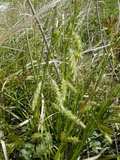
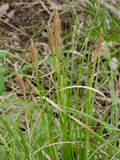
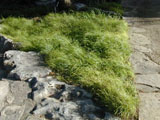
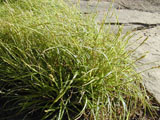
Texas Sedge, is a good turf substitute for dry to moist shade, colonizing densely by rhizomes. Its fine-textured foliage mixes nicely with other small, shade-loving plants like Cedar Sage (Salvia roemeriana), Baby Blue Eyes (Nemophila phacelioides), and White Avens (Geum canadense) to create a serene woodland garden. It can be mowed at a high setting.
From the Image Gallery
More Grasses or Grass-like Questions
Grass Groundcover for Georgia Hillside
July 07, 2016 - I am looking for a grass to cover a hillside area down to a lake. It is mostly sunny in the spring & summer, but has no moisture except any rain that falls. I am not interested in having to mow it all...
view the full question and answer
Trimming of native Muhlenbergia dumosa (Bamboo grass)
January 27, 2008 - Should Muhlenbergia dumosa (Bamboo grass) be cut down in a similar fashion to other perennial grasses that go dormant in the winter.
view the full question and answer
Plants for full-sun landscape
November 20, 2007 - I live in a very rocky area just outside of Fort Worth, TX. It's taken me all spring, summer & now I'm going into the fall, to landscape just 30 feet in front of my house. The front of the house get...
view the full question and answer
Low maintenance grass for shade in Conroe, TX
September 15, 2012 - What is the best low maintenance grass to plant in front lawn shaded, no traffic area?
view the full question and answer
Erosion controlling plants for a shady Minnesota lakeside
August 11, 2015 - I live about 50 yards from a lake and there is a steep embankment. Recently someone decided to cut the trees off the embankment and now the dirt is eroding off the embankment as well as off my back ya...
view the full question and answer
| Support the Wildflower Center by Donating Online or Becoming a Member today. |