Native Plants

Q. Who is Mr. Smarty Plants?
A: There are those who suspect Wildflower Center volunteers are the culpable and capable culprits. Yet, others think staff members play some, albeit small, role. You can torture us with your plant questions, but we will never reveal the Green Guru's secret identity.

Did you know you can access the Native Plant Information Network with your web-enabled smartphone?

Ask Mr. Smarty Plants
Ask Mr. Smarty Plants is a free service provided by the staff and volunteers at the Lady Bird Johnson Wildflower Center.

rate this answer

Friday - April 24, 2015
From: Salado, TX
Region: Southwest
Topic: Groundcovers
Title: Native ground cover for bare ground
Answered by: Nan Hampton
QUESTION:
I have a 20 x 40 foot partly sunny area that has only leaves covering the bare ground. I want to replace the leaves with ground cover. Can I mix ground covers like clover, asian jasmine, etc? I would prefer to use only native plants. Also, will I need to cover the area with a quality topsoil before I start planting? Thanks in advance. Jack RobinsonANSWER:
Certainly you can mix groundcovers but if you want them to be native plants, you don't want to use Trachelospermum asiaticum Asian jasmine. It is, as its name suggests, a native of Asia (Japan and Korea) and not a North American native. Most familiar clovers such as Trifolium repens (white clover) and Trifolium pratense (Red clover) are also non-native.
Here are several native groundcovers that will do well in part shade:
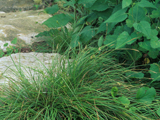
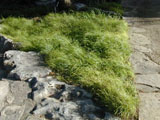
Sedges—Carex planostachys (Cedar sedge) and Carex texensis (Texas sedge) are both good choices for shade or part shade.
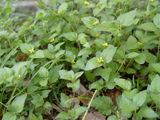
Calyptocarpus vialis (Straggler daisy) is a low herbaceous plant that grows in sun, part shade or shade and remains evergreen in mild winters.
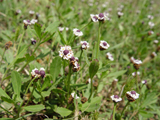
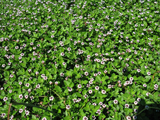
Phyla nodiflora (Texas frogfruit) will grow in sun and part shade and tolerates drought and flooding.
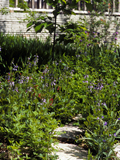
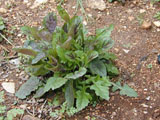
Salvia lyrata (Lyreleaf sage) grows in sun, part shade or shade and is evergreen. It grows from one to two feet tall and can be mowed.
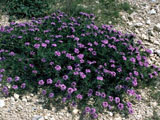
Glandularia bipinnatifida var. bipinnatifida (Prairie verbena) grows to only 6 to 12 inches high in sun and part shade. It has a very long blooming period.
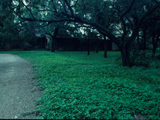
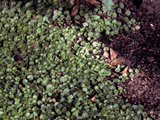
Dichondra carolinensis (Carolina ponysfoot) is very low-growing and grows in both sun and shade. You can see more photos in the Archive of Central Texas Plants.
It shouldn't be necessary to cover the area with topsoil. The Carex species you can buy in small pots to plant. It is probably a good idea to include a little compost in the hole for the plant. If you are sowing seeds it would be a good idea to remove the leaves and loosen the top of the soil to insure good contact with the seeds. Follow planting directions on the seed packages.
From the Image Gallery
More Groundcovers Questions
Drought-Tolerant, Evergreen Groundcover for CA
August 21, 2014 - We are looking for a drought tolerant, evergreen groundcover for California. I am considering Sarcococca hookeriana and Cotoneaster dammeri but don't know if they're the best options for the area. I...
view the full question and answer
Fast Growing Ground Cover for Sun in San Antonio
April 02, 2012 - What is the fastest growing ground cover for San Antonio Texas (predominantly sunny)?
view the full question and answer
Groundcover for Maryland to replace English ivy
September 21, 2009 - What is a suitable ground cover native replacement for english ivy? Native to Maryland.
view the full question and answer
Groundcover to prevent erosion in Florida
November 04, 2012 - I live on a hill and put in a new side driveway and now I am seeing erosion along the driveway and can see the bottom of my concrete. Grass won't grow because its all shaded. What would be the best g...
view the full question and answer
Source for silver ponyfoot from Temple TX
March 19, 2013 - Where can I purchase dichondra argentea -- I live in Bell Co. but am willing to come to Austin if need be.
Thank you.
view the full question and answer
| Support the Wildflower Center by Donating Online or Becoming a Member today. |