Native Plants

Q. Who is Mr. Smarty Plants?
A: There are those who suspect Wildflower Center volunteers are the culpable and capable culprits. Yet, others think staff members play some, albeit small, role. You can torture us with your plant questions, but we will never reveal the Green Guru's secret identity.

Did you know you can access the Native Plant Information Network with your web-enabled smartphone?

Ask Mr. Smarty Plants
Ask Mr. Smarty Plants is a free service provided by the staff and volunteers at the Lady Bird Johnson Wildflower Center.

rate this answer

Tuesday - February 03, 2015
From: Seattle , WA
Region: Northwest
Topic: Groundcovers, Wildflowers
Title: Low Groundcover for Washington State
Answered by: Anne Van Nest
QUESTION:
I'm trying to find a perfect fit for my piece of land in the State of Washington. I would say that the area is partly sunny and a somewhat moist area. I'm looking for a species of very small evergreen plant/groundcover/moss (grows 1-2 inches) that can be walked on (medium traffic) similar to grass or a tough groundcover. My intent is to plant this type of groundcover/moss in this area not be required to maintain it like normal grass. Any suggestions on a type of species that I could use to have a low maintenance grass-like area?ANSWER:
Finding low-growing native plants your Washington State land that will grow in a partly sunny, moist area isn't difficult. But finding plants that can tolerate foot traffic in this group is the difficult task. Perhaps a suggestion is to grow a low groundcover in the area and to place stepping stones or a foot path through the groundcover that way your pool of potential plants is larger.
To find the plants that grow in your state start with the Native Plant Database on our website. Select the Washington, semi-shade, moist, 0-1 feet selection criteria. In addition to many ferns, some of the possible groundcovers include:
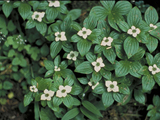
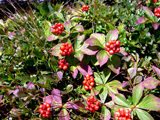
Cornus canadensis (bunchberry) (not tolerant of foot traffic) The slender 3-6 in. stalks of this perennial, woodland ground cover are topped by a whorl of oval, pointed leaves above which rises a white to greenish, dogwood blossom. Erect stems grow in extensive low patches, with 1 whorl of leaves at top and, just above, a cluster of tiny greenish flowers surrounded by 4 ovate white or pinkish bracts. The flower cluster resembles a single large flower held on a short stalk above leaves. A cluster of bright red berries follows. The leaves, which are dark-green and shiny in summer, become wine-red in fall. It spreads by underground stems. Among the smallest of a genus of mostly shrubs and trees, Bunchberry makes an excellent ground cover in the moist woodland garden and is equally attractive in flower or fruit.
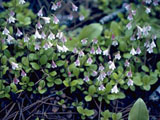
Linnaea borealis (twinleaf) This is a creeping ground cover with trailing stems reaching 3 ft. in length. These groups of slender, woody stems bear glossy, bright, evergreen leaves arranged in pairs. The delicately fragrant flowers are pinkish, bell-shaped and in nodding pairs at the end of 4-6 in. stalks.A low, delicate, matted evergreen plant with trailing stems having short, upright branches, each terminated by 2 pinkish-white, nodding bell-shaped flowers. Stems hairy. Twinflower was a favourite of the great Swedish botanist, Carl von Linne, who invented the system of binomial nomenclature.
A beautiful trailing plant of the North, this is the American variety of the European plant. It was named for Carolus Linnaeus (1707-1778), the father of modern botany, who was so fond of the flower he had his portrait painted with it. This charming plant makes a good ground cover in the woodland garden.
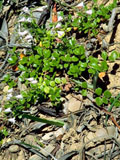
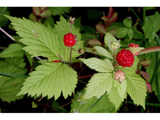
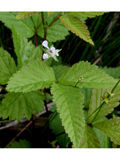
Rubus pubescens (dwarf red blackberry) A good, trailing groundcover for rich, moist, shady areas in the north. Ranging across northern Eurasia and northern North America as far south as montane Colorado, West Virginia, and Oregon, this diminutive, trailing Rubus species has decorative white flowers and red fruit. It prefers rich, moist, woodland soil. Its fruit is edible but slightly tart and with little pulp. Would make a good groundcover in moist, forested northern landscapes.
From the Image Gallery
More Wildflowers Questions
Erosion Control Shrubs and Groundcovers for Steep NY Wooded Slope
November 28, 2015 - I need to cover a couple of very steep slopes in upstate New York that are partially wooded and near a brook. The slopes are about 130 feet back from the brook. Someone estimated that there is a coupl...
view the full question and answer
Germinating Penstemon tenuis, Monarda citriodora and Machaeranthera tanacetifolia Seed
June 03, 2013 - I am a graduate student at Texas Tech (UT Austin alumni), studying horticulture. I will be researching several wildflowers found in west Texas including Penstemon tenuis, Monarda citriodora, and Macha...
view the full question and answer
Optimal time to separate and transplant black-eyed Susan
May 26, 2007 - When is the optimal time to separate or transplant black eyed Susan. I have some in a planter on my patio, but it has multiplied and become too crowded for the pot; it needs water daily.
view the full question and answer
Texas natives that attract butterflies but not deer
December 13, 2012 - I'd like to have some plants in my garden that are butterfly attractors, but that whitetail deer won't like. I can find lists of butterfly plants, and lists of deer-resistant plants -- is there a li...
view the full question and answer
2012 wildflower forecast from Friendswood TX
September 29, 2011 - What is your current view of the 2012 Wildflower Forecast? What weeks might be best for someone traveling from Colorado to see our flowers? We are concerned about what the drought will do to the 20...
view the full question and answer
| Support the Wildflower Center by Donating Online or Becoming a Member today. |