Native Plants

Q. Who is Mr. Smarty Plants?
A: There are those who suspect Wildflower Center volunteers are the culpable and capable culprits. Yet, others think staff members play some, albeit small, role. You can torture us with your plant questions, but we will never reveal the Green Guru's secret identity.

Did you know you can access the Native Plant Information Network with your web-enabled smartphone?

Ask Mr. Smarty Plants
Ask Mr. Smarty Plants is a free service provided by the staff and volunteers at the Lady Bird Johnson Wildflower Center.

rate this answer

Sunday - November 30, 2014
From: Austin, TX
Region: Southwest
Topic: Invasive Plants, Septic Systems, Trees
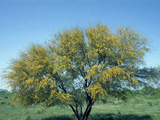
Title: Does Acacia farnesiana (Huisache) have agressive roots?
Answered by: Nan Hampton
QUESTION:
Hello, Do you know if the Huisache tree has an aggressive root system? I have a few in proximity to my septic draining field and I need to know if I should cut them down to prevent clogging of the septic drainage lines. Your help is more than appreciated! Thank youANSWER:
There are two opinions for your question about Acacia farnesiana (Huisache) roots:
- From the University of Florida IFAS Extension—"Roots: not a problem"
- From Homeguides.SFgate.com—"Many acacia species have aggressive root systems...". However, they are mainly talking about acacia trees from Australia and they don't name Acacia farnesiana as one of the acacias with aggressive root systems.
Another source, an article, Choosing "Sewer Safer" Trees?" from the University of Tennessee Extension has useful information about planting trees that are "sewer safe". In their recommendations they advise planting more than 10 feet from sewer lines to minimize root intrusion. Although they do not mention Acacia farnesiana (huisache) as possibility (it is a native of the Southwest, not Tennessee), they do recommend planting a small, slow-growing tree to avoid problems with roots and sewer lines—the huisache does match those criteria.
From the Image Gallery
More Trees Questions
Symmetrical Holes in Live Oak leaves.
April 08, 2009 - We have 2 young live oaks - quercus virginianum trees and their brand new leaves show two symmetrical rows of pin-sized holes punctured along the length of them. What could have caused this?
view the full question and answer
Quercus polymorpha or Mexican white oak
June 19, 2007 - On the Texas Oak Wilt Information Partnership website, they list a "Monterrey Oak" as one of the White Oaks (#3 in the FAQ section). I cannot find Monterrey Oak in your Explore Plants section; does...
view the full question and answer
Use of fresh clippings from tree trimmers for mulch in Austin
May 02, 2010 - Hi, The tree trimmers are in my neighborhood (east central Austin) to clear the power lines and said I can have a load of free mulch. I am wondering if there is any harm in using the fresh mulch from...
view the full question and answer
Protecting a new patio from oak roots
September 01, 2008 - Hello,
I have just formed up for a new patio. I have a Live Oak tree about 2' away from the patio. It has a trunk diameter of about 10", I believe 20-25 years old. Problem: I have 2 large roots in ...
view the full question and answer
Bald cypress knees in leachfield from Ventura CA
March 20, 2013 - Hey, I planted a seedling 20+ years ago which has turned out to be a 40'bald cypress that's now 40'. I'm a native southerner and would hate to cut it down but it's putting up knees in my septic s...
view the full question and answer
| Support the Wildflower Center by Donating Online or Becoming a Member today. |