Native Plants

Q. Who is Mr. Smarty Plants?
A: There are those who suspect Wildflower Center volunteers are the culpable and capable culprits. Yet, others think staff members play some, albeit small, role. You can torture us with your plant questions, but we will never reveal the Green Guru's secret identity.
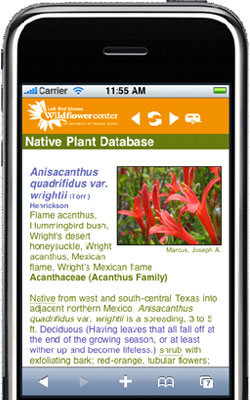
Did you know you can access the Native Plant Information Network with your web-enabled smartphone?
Ask Mr. Smarty Plants
Ask Mr. Smarty Plants is a free service provided by the staff and volunteers at the Lady Bird Johnson Wildflower Center.

rate this answer

Wednesday - May 28, 2014
From: Greenfield, MA
Region: Northeast
Topic: Diseases and Disorders, Herbs/Forbs
Title: Brown leaf problem with herbaceous blooming plants from Greenfield MA
Answered by: Barbara Medford
QUESTION:
I have 3 plants cimicifuga brunette and lots of astile planted near each other. Suddenly the edges of leaves have turned brown and shriveled and spread to entire plant, all of them. It has not been hot yet, they are well watered, has been raining often this spring. They are planted in rich soil. This was sudden and is spreading from plant to plant. The conditions have always been perfect. It is as if there is a blight. Any thoughts on this? Thank you.ANSWER:
The Lady Bird Johnson Wildflower Center, home of Mr. Smarty Plants, is dedicated to the growth, propagation and protection of plants native not only to North America, but also to the place in which they are being grown; in your case, Franklin County, Massachusetts. We found no plant, native or non-native, with the name of "Astile," so we figured you meant "Astilbe." The genus Astilbe native to North America is Astilbe biternata (Appalachian false goat's beard). If you follow that plant link to our webpage on that plant you will see that it is native to southeastern states. As you can see from this USDA Plant Profile Map, this plant grows natively as near to Massachusetts as Virginia and West Virginia.
With the Cimicifuga brunette, we had a little more trouble, not finding any genus by that name in our Native Plant Database. However, we went to the Internet and discovered from this article from the Missouri Botanical Garden that all members of the Cimicifuga genus have been transferred to the Acteae genus and that it is now a cultivar correctly termed Actaea simplex 'Brunette.' Being a cultivar would mean it would not be in our Native Plant Database, but neither is Actaea simplex. In that same article we learned that this plant is sometimes referred to as "cohosh," or "bugbane" both of which are common names in our database of Actaea racemosa var. racemosa (Black cohosh) .
Botanists move in mysterious ways, and names get changed on plants without notice sometimes; we believe that your Cimicifuga brunette is actually Actaea racemosa var. racemosa (Black cohosh). According to this USDA Plant Profile Map, it does grow natively in Franklin Co., Massachusetts.
We go through all this rigamarole to determine if a problem could be due to the plant being raised somewhere that does not have appropriate soils, climate or rainfall for that plant. However, we believe both your plants should be all right where you are growing them, and since they are different plants with the same (and spreading) symptoms, something else, a blight or disease, must be causing the trouble. Since we are gardeners, and not entomologists or plant pathologists, we need to refer you to some experts in your area who may already know what is going on.
The University of Massachusetts at Amherst maintains an Extension Office for Western Massachusetts. On that site, you will find a Plant Problems Diagnostics website. This has contact information and the people there may very well already be familiar with the problem and know what to suggest you do.
From the Image Gallery


More Herbs/Forbs Questions
Butterfly Plants for Chicago
September 13, 2014 - I live near Chicago, IL and am interested in planting a butterfly garden. Not sure when to start, but I want all native plants that would attract butterflies. Can you please let me know which plants ...
view the full question and answer
Looking for Irises for Coryell County, TX.
May 07, 2012 - I'm looking for a hearty plant for Coryell County, TX. My mother always referred to these plants as "flags." I assume it is a type of iris. I'm looking for the one that will survive in the Cent...
view the full question and answer
Propagation of Blackfoot daisy seed
July 21, 2015 - I have a three yr old Blackfoot daisy. How do you root Blackfoot daisy seeds? When is the best month to grow these seeds?
view the full question and answer
Iris brevicaulis in Southwest Michigan
April 22, 2007 - We live in Kalamazoo, MI (Southwest Michigan Zone 6) and discovered last year that we have an iris brevicaulis (we think) growing (and very pretty) on our property. It has the "zig zag" stem. It see...
view the full question and answer
Something eating Monarda didyma in Washington DC
June 30, 2011 - Please Help, I have a couple of Bee Balm, Jacob Cline, plants, whose leave are being eaten, by what I do not know. None of the nurseries around here seem to have ever heard of this happening to this p...
view the full question and answer
| Support the Wildflower Center by Donating Online or Becoming a Member today. |