Native Plants
Q. Who is Mr. Smarty Plants?
A: There are those who suspect Wildflower Center volunteers are the culpable and capable culprits. Yet, others think staff members play some, albeit small, role. You can torture us with your plant questions, but we will never reveal the Green Guru's secret identity.
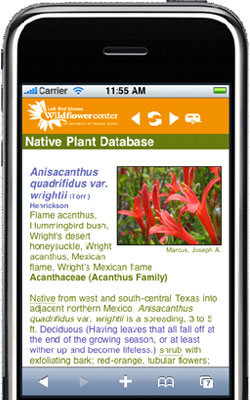
Did you know you can access the Native Plant Information Network with your web-enabled smartphone?
Ask Mr. Smarty Plants
Ask Mr. Smarty Plants is a free service provided by the staff and volunteers at the Lady Bird Johnson Wildflower Center.
rate this answer

Thursday - May 15, 2014
From: Tampa, FL
Region: Southeast
Topic: Privacy Screening, Shrubs, Trees
Title: Privacy Hedge Suggestions for Tampa, Florida
Answered by: Anne Van Nest
QUESTION:
My back wall is made of stone and is about 6' high. We are very close to a busy road. I need a plant that will reach about 7-8 feet high or a hedge to reduce some of the noise. What plant/hedge would you recommend? I live in Tampa, FL so it is very hot during the summer months.ANSWER:
The first place to go to find a list of potential plants is our Native Plants Database. There are two ways to find potential plants. Either use the Combination Search feature or the Recommended Species. The volunteers and staff at the Wildflower Center who maintain the database have partners in different regions to help with these recommended species lists based on what is easy to access in local nurseries.
Under Combination Search, select the following categories: State – Florida, Habit – Tree (or Shrub), Duration – Perennial, Light Requirement – Sun.
Under the Recommended Species list, select Central Florida, then sort by height - 6-12 feet.
These search criteria will give you a list of plants to consider. Follow each plant link to our webpage for that plant to learn its growing conditions, bloom time, etc. At the bottom of each plant webpage, under Additional Resources, there is a link to the USDA webpage for that plant. Take a look there for more specific details about suitability before you put them on your final planting list.
Trees and shrubs that grow to 6-12 feet tall for consideration in Central Florida:
Asimina obovata (Bigflower pawpaw)
Cephalanthus occidentalis (Common buttonbush)
Dodonaea viscosa (Florida hopbush)
Vaccinium stamineum (Deerberry)
Sambucus nigra ssp. canadensis (Common elderberry)
Quercus chapmanii (Chapman oak)
Ilex verticillata (Common winterberry)
When selecting your screening plants, consider the foliage type (evergreen vs. deciduous) and the soil moisture levels. Some of the above plants prefer more moist vs. dryer soils. Try to pick the plants that best match your garden conditions with their natural environment. Also Ilex verticillata and Ilex glabra are dioecious and needs both a male and female plant for the best fruiting.
From the Image Gallery



More Shrubs Questions
Is Savannah Holly poisonous to burn in Hanahan, SC.?
August 20, 2011 - Can you please tell me if the wood from a savannah holly bush is poisonous to burn?
view the full question and answer
Plants for a sandy slope at a weekend cabin in central WI.
June 30, 2009 - I have a cabin in central Wisconsin where the soil is equivalent to a sandy beach. There are some areas that are nearly impossible to mow because of how steep the incline is. Could you recommend som...
view the full question and answer
Plants for wet soils in North Carolina
October 03, 2009 - I'm looking for evergreen plants (shrubs or ground cover)that will tolerate wet conditions for the zone 8 area of North Carolina. The local garden centers here do not stock these types of plants, eve...
view the full question and answer
Sunny and shady lawns from Austin
April 28, 2012 - My front yard has a large bed surrounded by a mix of St. Augustine and Bermuda grass. Last summers heat killed off about 90% of the St. Augustine, which we would like to replace anyway to conserve re...
view the full question and answer
Bottlebrush buckeye not leafing out from Newburyport MA
June 11, 2013 - We have a bottlebrush buckeye bush that has grown and blossomed for 16 years. This spring the bush failed to produce any leaves and there are no buds in anticipation of leaves. There are a few smaller...
view the full question and answer
| Support the Wildflower Center by Donating Online or Becoming a Member today. |