Native Plants

Q. Who is Mr. Smarty Plants?
A: There are those who suspect Wildflower Center volunteers are the culpable and capable culprits. Yet, others think staff members play some, albeit small, role. You can torture us with your plant questions, but we will never reveal the Green Guru's secret identity.

Did you know you can access the Native Plant Information Network with your web-enabled smartphone?

Ask Mr. Smarty Plants
Ask Mr. Smarty Plants is a free service provided by the staff and volunteers at the Lady Bird Johnson Wildflower Center.

rate this answer

Monday - March 10, 2014
From: Louisville, KY
Region: Mid-Atlantic
Topic: Privacy Screening, Shade Tolerant
Title: Shade tolerant evergreens for privacy shield in Louisville KY
Answered by: Barbara Medford
QUESTION:
Dear Mr. Smarty Plants, Our property is adjacent to the highway for ~ 200ft. I'm looking for partial-to-full shade tolerant evergreens that will grow to be relatively tall. Our soil is clay and generally moist excepting mid-summer. I saw some of your posts for higher USDA zones, but am having a little trouble finding zone 6 species (considering A. gigantea if I can find some).ANSWER:
We were not sure what "A. gigantea" is referring to. There is Agathia gigantea (from The Moths of Borneo) or Aechmea gigantea (From the Encyclopedia of Life). But what we think you are referring to is Arundinaria gigantea (Giant cane). More information from the University of Florida Center for Aquatic and Invasive Plants. From the Missouri Botanical Garden, here is an article about Giant Cane Bamboo, which includes this sentence:
"Best grown in consistently moist soils in full sun."
The Lady Bird Johnson Wildflower Center, home of Mr. Smarty Plants, is dedicated to the growth, protection and propagation of plants native not only to North America but to the area in which they are being grown; in your case, Jefferson Co., KY. According to this USDA Plant Profile Map Arundinaria gigantea (Giant cane) does indeed grow natively in Jefferson County, so you should not have to worry about the zone you are in. That is the beauty of using native plants - they are already growing in the right soil, climate and rainfall.
If you follow this plant link, Arundinaria gigantea (Giant cane), to our webpage on this plant, you will see these growing conditions:
"Growing Conditions
Water Use: Medium
Light Requirement: Part Shade
Soil Moisture: Wet
CaCO3 Tolerance: Low
Soil Description: Wet soils."
We consider "part shade" to be 2 to 6 hours of sun a day. That differs from the light requirements cited in the article from the Missouri Botanical Garden, above. Our Image Gallery contains no pictures of this plant, so here are images from Google.
Since so many bamboos can be invasive, we are going to search our Native Plant Database for some other possible plants for your purpose, considering your soils, sunlight and location.
When we put all the other requirements in, we got 67 possibilities; when we added "evergreen," there were 12 possibilities. Several of those were low, ground-hugging plants, such as Epigaea repens (Trailing arbutus) (1-2 ft. tall) and Gaultheria procumbens (Eastern teaberry) (1-3 ft), neither of which are native to Jefferson Co. Taller evergreen plants are Mahonia aquifolium (Hollyleaved barberry), on which there was no information on where in Kentucky it will grow and Kalmia latifolia (Mountain laurel), USDA Plant Profile showing it native to Bullitt County, right next to Jefferson Co.
We feel we are letting you down, but there just don't seem to be many plants that will fill your requirements. However, there are two members of the genus Ilex (holly) that fit a lot of your requirements and are native at least close to Jefferson County:
Ilex opaca (American holly) USDA Plant Profile Map
Ilex verticillata (Common winterberry) USDA Plant Profile Map
Why those didn't show up in our initial search, who knows? We suggest that you follow all of our plant links to the pages on those plants, study their size and growing conditions and see if you can find something that will work for you.
From the Image Gallery
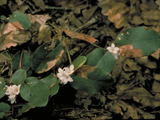
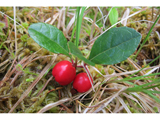
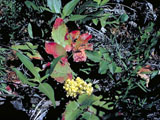
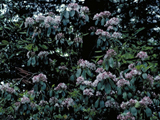
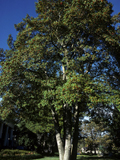
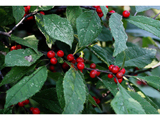
More Privacy Screening Questions
Screen of Thuja Occidentalis on fire-damaged property in Bastrop TX
May 04, 2013 - I want to plant a screen of Thuja Occidentalis on the east side of our driveway. It is in the burn area of Bastrop, TX. None of our trees survived. Will Thuja Occidentalis grow here? I saw some specim...
view the full question and answer
Non-poisonous, non-allergenic plants for privacy fence
March 15, 2012 - I'm looking to put in some plants to create a privacy fence against one side of my property. I'd like a mix of plants that grow well together in order to create a diverse look. I need something ever...
view the full question and answer
Privacy screen shrubs for Butler PA
August 09, 2013 - Here is what I want in a bush: native to Western Pa.(Southern Butler County), appropriate for a horse pasture,fast growing, not too aggressive (I will mow around it regularly and can prune occasionall...
view the full question and answer
Privacy screen from Simpsonville SC
May 04, 2013 - My neighbor cut down his part of our shared woods so now we see his whole "outside patio area". What kinds of fast growing shade loving trees and shrubs can we plant on our property line that will c...
view the full question and answer
Screen for utility box in Seabrook TX
February 21, 2011 - Utility box cover: Thinking of using star jasmine on a three sided fence/trellis. Each side 3 ft sq. I can send a picture. Not sure best fence style to use or way to plant. Suggestions? Need cove...
view the full question and answer
| Support the Wildflower Center by Donating Online or Becoming a Member today. |