Native Plants

Q. Who is Mr. Smarty Plants?
A: There are those who suspect Wildflower Center volunteers are the culpable and capable culprits. Yet, others think staff members play some, albeit small, role. You can torture us with your plant questions, but we will never reveal the Green Guru's secret identity.

Did you know you can access the Native Plant Information Network with your web-enabled smartphone?

Ask Mr. Smarty Plants
Ask Mr. Smarty Plants is a free service provided by the staff and volunteers at the Lady Bird Johnson Wildflower Center.

rate this answer

Wednesday - February 26, 2014
From: Milford, OH
Region: Mid-Atlantic
Topic: Shrubs
Title: Replacement for boxwoods in Ohio
Answered by: Nan Hampton
QUESTION:
I want to replace my boxwood plants but I don't know what would be a good replacement. I have a hydrangea plant that is in the middle and I would like something to go on each side of the hydrangea. It can't be over 4 feet tall and it will get morning sun. Any suggestions?ANSWER:
Here are four possibilities to replace your boxwood plants. All of these are natives known to grow in or very near Clermont County. You can look for more possibilities by doing a COMBINATION SEARCH in our Native Plant Database and choosing "Ohio" from the Select State or Province option, "Shrub" from Habit (general appearance) and "3-6 ft." from Size Characteristics.
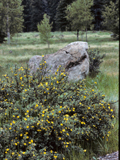
Dasiphora fruticosa ssp. floribunda (Shrubby cinquefoil) Here are more photos and information from Go Botany New England Wild and from Plants of Wisconsin.
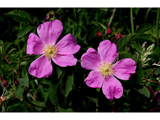
Rosa blanda (Smooth rose) Here is more information from Minnesota Wildflowers and from Evergreen Native Plant Database.
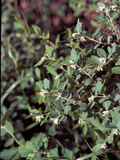
Symphoricarpos albus (Common snowberry) Here is more information from Missouri Botanical Garden and University of Connecticut Horticulture.
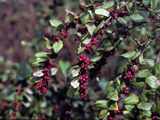
Symphoricarpos orbiculatus (Coralberry) Here is more information from Missouri Botanical Garden and from Washington State University Whatcom County Extension.
From the Image Gallery
More Shrubs Questions
Growing rabitteye blueberries in Phenix City AL
January 18, 2013 - What type soil is needed to grow rabbiteye blueberries?
view the full question and answer
Windbreak [Dustbreak] for Shelton, WA
May 31, 2013 - I live on a well traveled, dusty, gravel road in the Pacific North West and would like to plant a barrier to help control the dust.
view the full question and answer
Evergreen shrub for hedge in Porter, Texas
December 24, 2010 - We are trying to decide on what would be good privacy hedges (at least 6 ft. tall) to run down our long backyard chainlink fences. I'm allergic to Ligustrums and we have 2 dogs and a cat which I hear...
view the full question and answer
Removal of non-native invasive Ligustrum japonica from Austin
February 14, 2012 - I bought a house that I am slowly turning into a native garden, but as a teacher, I have a really small budget. One entire border of my backyard (30 feet) was planted with evil Ligustrum japonica. I l...
view the full question and answer
Hedge in Desert Full Sun
March 25, 2012 - We want a short hedge, 2-3 ft tall, small leaves that fill in to full looking hedge. It is in Phoenix Arizona area and gets full sun all afternoon
view the full question and answer
| Support the Wildflower Center by Donating Online or Becoming a Member today. |