Native Plants

Plant Database
Search for native plants by scientific name, common name or family. If you are not sure what you are looking for, try the Combination Search or our Recommended Species lists.
Bransford, W.D. and Dolphia
Vernonia baldwinii
Vernonia baldwinii Torr.
Western Ironweed, Baldwin's Ironweed, Ironweed
Asteraceae (Aster Family)
Synonym(s):
USDA Symbol: veba
USDA Native Status: L48 (N)
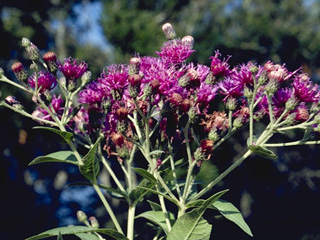
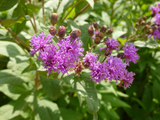
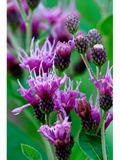
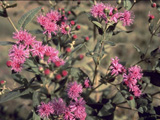
Western ironweed’s 3-5 ft. stems occur singly or in clumps, and are stout and hairy. Wide clusters of vibrant, red-violet flowers form at the ends of short branches near the top of the plant. Because the flowers are all of the disc variety, the 6 in. wide flower cluster has a fuzzy appearance. Long, lance-shaped leaves line the stems.
This plant aggressively colonizes by rhizomes once established so place accordingly. Its bloom period lasts until frost.


Plant Characteristics
Duration: PerennialHabit: Herb
Size Notes: Up to about 5 feet tall.
Fruit: Fruit is a cypsela (pl. cypselae). Though technically incorrect, the fruit is often referred to as an achene.
Bloom Information
Bloom Color: Pink , PurpleBloom Time: Jul , Aug , Sep , Oct , Nov
Distribution
USA: AR , CO , IA , IL , KS , LA , MN , MO , NE , NM , OK , SD , TXNative Distribution: S.c. IL to NE, s. to LA & TX
Native Habitat: Disturbed sites; open woods; fields
Growing Conditions
Water Use: LowLight Requirement: Sun
Soil Moisture: Moist
Soil Description: Rocky or sandy soils. Clay, Clay Loam, Medium Loam, Sandy Loam, Sandy, Limestone-based, Caliche type
Conditions Comments: Best in natural areas and large meadows where large colonies can be appreciated. Can be rampant colonizer when planted in garden soils. Roots travel in all directions from plant about one foot deep. Difficult to control once plant is well established. Bloom period lasts from summer until frost.
Benefit
Use Ornamental: Perennial garden, Pocket prairieConspicuous Flowers: yes
Attracts: Birds , Butterflies
Deer Resistant: High
Value to Beneficial Insects
Special Value to Native BeesThis information was provided by the Pollinator Program at The Xerces Society for Invertebrate Conservation.
Propagation
Propagation Material: SeedsDescription: Few seeds are fertile, so sow thickly when soil temperature is warm. May also be propagated by root division and softwood tip cuttings.
Find Seed or Plants
Order seed of this species from Native American Seed and help support the Wildflower Center.
National Wetland Indicator Status
| Region: | AGCP | AK | AW | CB | EMP | GP | HI | MW | NCNE | WMVE |
| Status: | UPL | UPL | FACU | UPL | UPL | FACW |
From the National Organizations Directory
According to the species list provided by Affiliate Organizations, this plant is on display at the following locations:Fredericksburg Nature Center - Fredericksburg, TX
Lady Bird Johnson Wildflower Center - Austin, TX
NPSOT - Fredericksburg Chapter - Fredericksburg, TX
NPSOT - Williamson County Chapter - Georgetown, TX
Bibliography
Bibref 946 - Gardening with Prairie Plants: How to Create Beautiful Native Landscapes (2002) Wasowski, SallyBibref 765 - McMillen's Texas Gardening: Wildflowers (1998) Howard, D.
Bibref 318 - Native Texas Plants: Landscaping Region by Region (2002) Wasowski, S. & A. Wasowski
Bibref 248 - Texas Wildflowers: A Field Guide (1984) Loughmiller, C. & L. Loughmiller
Bibref 1294 - The Midwestern Native Garden: Native Alternatives to Nonnative Flowers and Plants An Illustrated Guide (2011) Adelman, Charlotte and Schwartz, Bernard L.
Bibref 328 - Wildflowers of Texas (2003) Ajilvsgi, Geyata.
Bibref 286 - Wildflowers of the Texas Hill Country (1989) Enquist, M.
Search More Titles in Bibliography
Additional resources
USDA: Find Vernonia baldwinii in USDA PlantsFNA: Find Vernonia baldwinii in the Flora of North America (if available)
Google: Search Google for Vernonia baldwinii
Metadata
Record Modified: 2018-07-16Research By: LAL