Native Plants

Plant Database
Search for native plants by scientific name, common name or family. If you are not sure what you are looking for, try the Combination Search or our Recommended Species lists.
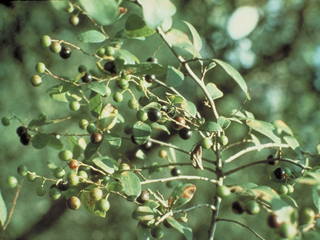
Dunatchik, David
Vaccinium arboreum
Vaccinium arboreum Marshall
Farkleberry, Tree Sparkleberry, Sparkleberry, Winter Huckleberry, Huckleberry
Ericaceae (Heath Family)
Synonym(s): Batodendron andrachniforme, Batodendron arboreum, Vaccinium arboreum var. glaucescens
USDA Symbol: vaar
USDA Native Status: L48 (N)
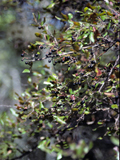
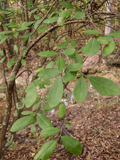
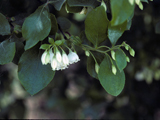
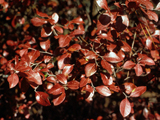
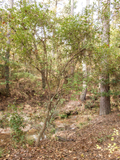
Tree sparkle-berry is a coarse, spreading, deciduous shrub or small tree. It usually grows 12-15 ft., but can reach 30 ft. Fragrant flowers resemble tiny, white bells. Inedible, persistent, black berries follow. Shiny, dark-green leaves turn deep-red in the fall. Bark exfoliates and is composed of grays, rich browns, oranges, and reddish-browns. A shrub or tree with short trunk, irregular crown of crooked branches, small, glossy, elliptical leaves, and shiny black berries.
This is the tallest of the genus of blueberries, often called huckleberries. The fruit has thin, slightly sweet pulp and large seeds. Although not palatable to humans, the berries are consumed by wildlife.
Plant Characteristics
Duration: PerennialHabit: Tree
Leaf Retention: Deciduous , Evergreen
Leaf Complexity: Simple
Fruit Type: Berry
Size Notes: Up to about 30 feet tall.
Leaf: Dark Green
Flower: Flowers 1/2 inch
Fruit: Blue
Bloom Information
Bloom Color: WhiteBloom Time: Mar , Apr , May , Jun
Distribution
USA: AL , AR , FL , GA , IL , IN , KS , KY , LA , MO , MS , NC , OK , SC , TN , TX , VANative Distribution: S.e. VA to s. IN & MO, s. to FL & TX
Native Habitat: Sandy, open woods; wooded stream banks; clearings
Growing Conditions
Water Use: MediumLight Requirement: Part Shade
Soil Moisture: Dry
CaCO3 Tolerance: Medium
Cold Tolerant: yes
Soil Description: Sandy or rocky, acid soils. Sandy, Sandy Loam, Acid-based
Conditions Comments: Sparkleberry leaves may hang on through the winter if the plant is protected from gusty winds. The shrub is susceptible to chlorosis due on high alkaline sites.
Benefit
Use Ornamental: Attractive, Understory tree, Fruits ornamental, Fall conspicuous, AromaticUse Wildlife: Fruit-birds, Fruit-mammals.
Conspicuous Flowers: yes
Attracts: Butterflies
Larval Host: Henry's Elfin, Striped hairstreak.
Value to Beneficial Insects
Special Value to Native BeesThis information was provided by the Pollinator Program at The Xerces Society for Invertebrate Conservation.
Butterflies and Moths of North America (BAMONA)
|
Striped Hairstreak (Satyrium liparops) 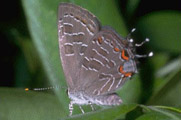 Larval Host |
Propagation
Propagation Material: SeedsDescription: Most commonly propagated by softwood cuttings taken in spring. Vaccinium will also root from hardwood cuttings of unbranched shoots of previous season. Seeds may need to be stratified and should be sown on a slightly acid soil mix.
Seed Treatment: Stratify for 60-90 days at 41 degrees.
Commercially Avail: yes
National Wetland Indicator Status
| Region: | AGCP | AK | AW | CB | EMP | GP | HI | MW | NCNE | WMVE |
| Status: | FACU | FACU | FACU | FACU |
From the National Organizations Directory
According to the species list provided by Affiliate Organizations, this plant is on display at the following locations:Pineywoods Native Plant Center - Nacogdoches, TX
Crosby Arboretum - Picayune, MS
Stengl Biological Research Station - Smithville, TX
Texas Parks and Wildlife Department - Austin, TX
Georgia Native Plant Society - Atlanta, GA
Mt. Cuba Center - Hockessin, DE
Wildflower Center Seed Bank
LBJWC-MLE-46 Collected 2010-11-03 in Hardin County by Lady Bird Johnson Wildflower CenterBibliography
Bibref 298 - Field Guide to Texas Trees (1999) Simpson, B.J.Bibref 1620 - Gardening with Native Plants of the South (Reprint Edition) (2009) Wasowski, S. with A. Wasowski
Bibref 355 - Landscaping with Native Plants of Texas and the Southwest (1991) Miller, G. O.
Bibref 318 - Native Texas Plants: Landscaping Region by Region (2002) Wasowski, S. & A. Wasowski
Bibref 291 - Texas Wildscapes: Gardening for Wildlife (1999) Damude, N. & K.C. Bender
Search More Titles in Bibliography
Web Reference
Webref 38 - Flora of North America (2019) Missouri Botanical Garden, St. Louis, MO & Harvard University Herbaria, Cambridge, MA.Research Literature
Reslit 252 - Effects of Self-pollination and Cross-pollination of Vaccinium darrowii (Ericaceae) and Other Low-chill Blueberries (2009) D. J. Chavez and P. M. LyreneReslit 158 - Population dynamics of thrips (Thysanoptera: Thripidae: Phlaeothripidae) inhabiting Vaccinium (Ericales: Ericaceae) galls in Georgia (1996) S. K. Braman, R. J. Beshear, J. A. Payne and A. A....
Reslit 174 - Derivatives of Vaccinium arboreum x Vaccinium section Cyanococcus. II. Fertility and fertility parameters (1998) S. J. Brooks and P. M. Lyrene
Reslit 175 - Level of self- and cross-fertility of derivatives of Vaccinium arboreum x Vaccinium section Cyanococcus hybrids (1998) S. J. Brooks and P. M. Lyrene
Reslit 176 - Derivatives of Vaccinium arboreum x Vaccinium section Cyanococcus: I. Morphological characteristics (1998) S. J. Brooks and P. M. Lyrene
Reslit 101 - Flammability of native understory species in pine flatwood and hardwood hammock ecosystems and implications for the wildland-urban interface (2004) A. L. Behm, M. L. Duryea, A. J. Long and W. C. Zip...
Reslit 321 - Uptake and assimilation of nitrate and iron in two Vaccinium species as affected by external nitrate concentration (2006) R. L. Darnell and S. A. Hiss
Reslit 850 - Value of various taxa in breeding tetraploid blueberries in Florida (1997) P. M. Lyrene
Reslit 851 - Germination and growth of sparkleberry seedlings (Vaccinium arboreum marsh) (1998) P. M. Lyrene
Reslit 941 - Ultrastructure of the fungus Ophiodothella vaccinii in infected leaves of Vaccinium arboreum (2006) C. W. Mims, R. T. Hanlin and E. A. Richardson
This information was provided by the Florida WIldflower Foundation.
Search More Titles in Research Literature
Additional resources
USDA: Find Vaccinium arboreum in USDA PlantsFNA: Find Vaccinium arboreum in the Flora of North America (if available)
Google: Search Google for Vaccinium arboreum
Metadata
Record Modified: 2022-10-11Research By: TWC Staff