Native Plants

Plant Database
Search for native plants by scientific name, common name or family. If you are not sure what you are looking for, try the Combination Search or our Recommended Species lists.
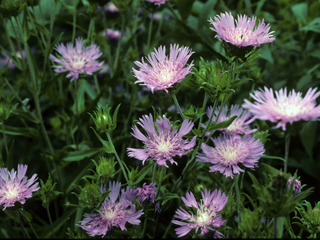
Wasowski, Sally and Andy
Stokesia laevis
Stokesia laevis (Hill) Greene
Stokes Aster
Asteraceae (Aster Family)
Synonym(s): Carthamus laevis
USDA Symbol: stla6
USDA Native Status: L48 (N)
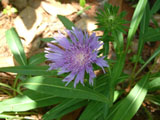
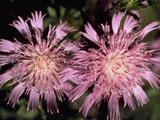
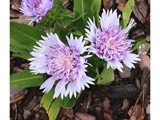
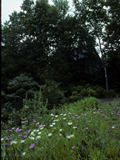
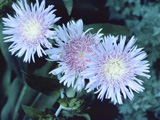
Stokes Aster is a low perennial, 12-24 in. tall, with a basal cluster of dark-green, lance-shaped leaves. The numerous, solitary, flower heads are 2-4 in. across, with deeply divided blue rays and very prominent blue florets from the disc.
This species readily self-sows and adapts to many conditions.
Plant Characteristics
Duration: PerennialHabit: Herb
Leaf Retention: Semi-evergreen
Inflorescence: Head
Size Notes: Up to about 2 feet tall.
Flower: Flowers 2 to 4 inches across
Fruit: Fruit is a cypsela (pl. cypselae). Though technically incorrect, the fruit is often referred to as an achene.
Bloom Information
Bloom Color: White , Blue , PurpleBloom Time: May , Jun , Jul , Aug , Sep
Bloom Notes: Will only bloom through the summer if you cut off the flowers before they seed.
Distribution
USA: AL , FL , GA , LA , MS , NC , SCNative Distribution: NC to LA, east of the Mississippi River.
Native Habitat: Coastal plains, bogs, pine savanna, and open woodlands.
Growing Conditions
Water Use: Medium , HighLight Requirement: Sun , Part Shade
Soil Moisture: Moist
Soil pH: Acidic (pH<6.8)
Drought Tolerance: Low
Heat Tolerant: yes
Soil Description: Moist, rich, well-drained soil, acidic sands preferred.
Conditions Comments: Winter hardy to Zone 5, well north of its native range.
Benefit
Use Ornamental: A low-maintenance, low-growing groundcovering plant with attractive flowers.Conspicuous Flowers: yes
Attracts: Butterflies
Nectar Source: yes
Propagation
Propagation Material: Root Cuttings , Root Division , SeedsDescription: May be propagated by root cuttings, seed, or division. Sow seeds in a cold frame in late winter, transplanting after the last frost. Take cutting of long, thick roots in the fall and make crown division in the spring or fall.
Seed Collection: Papery-brown bracts surround the nutlets which, when mature, are 1/4 in. long and brown. Maturation is almost two months after flowering. Many nutlets do not develop fully and should be separated out. Store dried nutlets in sealed, refrigerated containers.
Commercially Avail: yes
Maintenance: Colonizes vigorously, so lift and divide every 3 or 4 years if want to keep thinned.
National Wetland Indicator Status
| Region: | AGCP | AK | AW | CB | EMP | GP | HI | MW | NCNE | WMVE |
| Status: | FAC | FAC |
From the National Organizations Directory
According to the species list provided by Affiliate Organizations, this plant is on display at the following locations:Delaware Nature Society - Hockessin, DE
United States Botanic Garden - Washington, DC
Crosby Arboretum - Picayune, MS
First United Methodist Church of Jefferson City - Jefferson City, TN
Mt. Cuba Center - Hockessin, DE
Bibliography
Bibref 1620 - Gardening with Native Plants of the South (Reprint Edition) (2009) Wasowski, S. with A. WasowskiSearch More Titles in Bibliography
Web Reference
Webref 38 - Flora of North America (2019) Missouri Botanical Garden, St. Louis, MO & Harvard University Herbaria, Cambridge, MA.Webref 23 - Southwest Environmental Information Network (2009) SEINet - Arizona Chapter
Research Literature
Reslit 195 - Tolerance of Stokes aster to selected herbicides (1995) E. J. Callan and C. W. KennedyReslit 494 - Polyploidy in Stokes Aster (Stokesia laevis) (2005) J. Gaus, D. Werner and S. Tallury
Reslit 644 - In vitro propagation of white stokesia (Stokesia laevis Greene var. alba hort.) by leaf and root culture (1995) T. Hosoki, M. Mochida, T. Sakamoto and K. Ohta
Reslit 2050 - Fungal flora associated with discoloration of Stokes aster (Stokesia laevis) seed in Maryland (1979) R. A. Kilpatrick
Reslit 2085 - Stokes aster (2002) L. A. Gettys and D. J. Werner
Reslit 2140 - Intercropping Stokes Aster - Effect of Shade on Photosynthesis and Plant Morphology (1995) E. J. Callan and C. W. Kennedy
Reslit 2232 - Stokesia laevis: Taxonomy and economic value (1974) C. R. Gunn and G. A. White
Reslit 2514 - Genetics and biochemistry of flower color in stokes aster (2008) J. G. Barb, D. J. Werner and R. J. Griesbach
Reslit 2515 - Cytogenetic characterization and nuclear DNA content of diploid and tetraploid forms of stokes aster (2008) J. G. Barb, D. J. Werner and S. P. Tallury
This information was provided by the Florida WIldflower Foundation.
Search More Titles in Research Literature
Additional resources
USDA: Find Stokesia laevis in USDA PlantsFNA: Find Stokesia laevis in the Flora of North America (if available)
Google: Search Google for Stokesia laevis
Metadata
Record Modified: 2023-01-19Research By: TWC Staff