Native Plants

Plant Database
Search for native plants by scientific name, common name or family. If you are not sure what you are looking for, try the Combination Search or our Recommended Species lists.
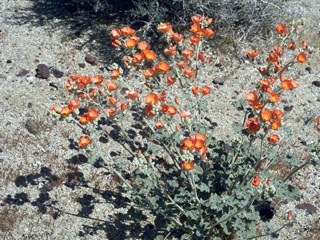
Bransford, W.D. and Dolphia
Sphaeralcea ambigua
Sphaeralcea ambigua A. Gray
Desert Globemallow, Apricot Globe-mallow, Desert Mallow, Globe Mallow, Apricot Mallow
Malvaceae (Mallow Family)
Synonym(s):
USDA Symbol: spam2
USDA Native Status: L48 (N)
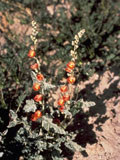
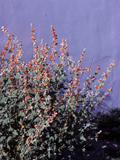
Shrubby and woolly, this perennial grows 1-3 ft., with numerous large, apricot-orange to pink flowers in wand-like clusters near the tips of weak, wide-ranging, usually erect stems. The broad leaves have three lobes and rounded, scalloped edges. A grayish plant often with many stems.
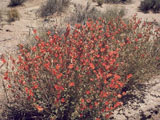
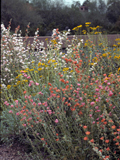
One of the largest-flowered, most drought-tolerant species of Globe-mallow. In wet years it forms spectacular displays in the low, hot southwestern deserts. In some forms petals are pale purplish-pink.

Plant Characteristics
Duration: PerennialHabit: Herb
Leaf Arrangement: Alternate
Leaf Complexity: Simple
Breeding System: Flowers Bisexual
Fruit Type: Schizocarp
Size Notes: Up to about 3 feet tall.
Leaf: Green
Bloom Information
Bloom Color: White , Pink , Orange , PurpleBloom Time: Feb , Mar , Apr , May , Jun , Jul , Aug , Sep , Oct , Nov
Bloom Notes: Apricot or red-orange, lavender, pink or white.
Distribution
USA: AZ , CA , NV , UTNative Distribution: S.w. UT to s. CA, s. to Oaxaca in southern Mex.
Native Habitat: Dry, rocky slopes; sandy wash edges to 3500 ft.
Growing Conditions
Water Use: LowLight Requirement: Sun
Soil Moisture: Dry
CaCO3 Tolerance: High
Soil Description: Dry, rocky or sandy soils.
Conditions Comments: This drought tolerant plant is the most xeriphytic of the Southwest Sphaeralceas. It is relatively short-lived but usually self-seeds.
Benefit
Use Wildlife: The large number of flowers produced over a year provides a steady source of pollen and nectar to honey bees and other insects.Conspicuous Flowers: yes
Value to Beneficial Insects
Special Value to Native BeesThis information was provided by the Pollinator Program at The Xerces Society for Invertebrate Conservation.
Propagation
Description: Plant untreated seed 1/4" deep in fall. Usually will germinate in the winter and grow rapidly in the spring.Seed Treatment: No treatment needed.
Commercially Avail: yes
Find Seed or Plants
Find seed sources for this species at the Native Seed Network.
From the National Organizations Directory
According to the species list provided by Affiliate Organizations, this plant is on display at the following locations:Naval Air Station Kingsville - Kingsville, TX
Texas Discovery Gardens - Dallas, TX
Sibley Nature Center - Midland, TX
NPSOT - Austin Chapter - Austin, TX
Native Seed Network - Corvallis, OR
Bibliography
Bibref 995 - Native Landscaping from El Paso to L.A. (2000) Wasowski, S. and A. WasowskiSearch More Titles in Bibliography
Web Reference
Webref 38 - Flora of North America (2019) Missouri Botanical Garden, St. Louis, MO & Harvard University Herbaria, Cambridge, MA.Webref 23 - Southwest Environmental Information Network (2009) SEINet - Arizona Chapter
Additional resources
USDA: Find Sphaeralcea ambigua in USDA PlantsFNA: Find Sphaeralcea ambigua in the Flora of North America (if available)
Google: Search Google for Sphaeralcea ambigua
Metadata
Record Modified: 2023-02-28Research By: TWC Staff