Native Plants

Plant Database
Search for native plants by scientific name, common name or family. If you are not sure what you are looking for, try the Combination Search or our Recommended Species lists.
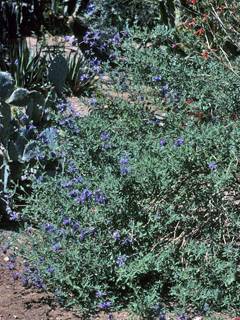
Wasowski, Sally and Andy
Salvia clevelandii
Salvia clevelandii (A. Gray) Greene
Fragrant Sage, Blue Sage, Cleveland Sage
Lamiaceae (Mint Family)
Synonym(s):
USDA Symbol: sacl
USDA Native Status: L48 (N)
A fragrant, rounded subshrub, 3-4 ft. tall and 4-6 ft. wide, with a heavy bloom of dark blue-violet flowers. Fragrant, wrinkled, gray leaves are sometimes used in cooking in place of the European garden sage.
Leaves are sometimes used in cooking in place of the European garden sage. Flowers attract bees and hummingbirds.
From the Image Gallery
Plant Characteristics
Duration: PerennialHabit: Shrub
Leaf Retention: Evergreen
Size Notes: Up to about 4 feet tall.
Fruit: Nutlets.
Bloom Information
Bloom Color: Blue , Purple , VioletBloom Time: Mar , Apr , May , Jun , Jul , Aug
Distribution
USA: CANative Distribution: S. CA to adjacent Mex.
Native Habitat: Dry slopes below 3000 ft.
Growing Conditions
Light Requirement: SunSoil Description: Well-drained sands & gravels.
Conditions Comments: Prune off old flower stalks in fall.
Value to Beneficial Insects
Special Value to Native BeesThis information was provided by the Pollinator Program at The Xerces Society for Invertebrate Conservation.
Propagation
Description: May be propagated by seed sown outdoors in early fall.Seed Collection: Collect the seeds as the capsules begin to dry but before they have dropped the seeds. Spread seeds in thin layers to dry a few days before storing in sealed, refrigerated containers.
Seed Treatment: No treatment is necessary.
Commercially Avail: yes
Find Seed or Plants
Find seed sources for this species at the Native Seed Network.
From the National Organizations Directory
According to the species list provided by Affiliate Organizations, this plant is on display at the following locations:Naval Air Station Kingsville - Kingsville, TX
Santa Barbara Botanic Garden - Santa Barbara, CA
Native Seed Network - Corvallis, OR
Bibliography
Bibref 995 - Native Landscaping from El Paso to L.A. (2000) Wasowski, S. and A. WasowskiSearch More Titles in Bibliography
Web Reference
Webref 37 - Calscape (2019) California Native Plant SocietyWebref 23 - Southwest Environmental Information Network (2009) SEINet - Arizona Chapter
Additional resources
USDA: Find Salvia clevelandii in USDA PlantsFNA: Find Salvia clevelandii in the Flora of North America (if available)
Google: Search Google for Salvia clevelandii
Metadata
Record Modified: 2023-02-24Research By: TWC Staff