Native Plants

Plant Database
Search for native plants by scientific name, common name or family. If you are not sure what you are looking for, try the Combination Search or our Recommended Species lists.
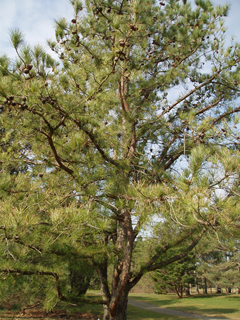
Makin, Julie
Pinus rigida
Pinus rigida Mill.
Pitch Pine, Torch Pine
Pinaceae (Pine Family)
Synonym(s):
USDA Symbol: piri
USDA Native Status: L48 (N), CAN (N)
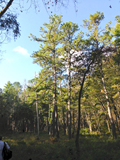
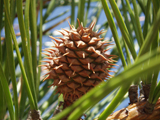
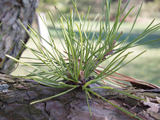
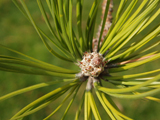
Pitch pine is a 40-70 ft., sometimes taller, evergreen with an irregular, globular form; twisting, gnarled, drooping branches; and scaly, reddish-brown bark which eventually becomes black. Stiff, yellow-green needles, in clusters of three, eventually turn dark-green. Medium-sized tree often bearing tufts of needles on trunk, with a broad, rounded or irregular crown of horizontal branches. Cones occur in whorls of 3-5.
Now used principally for lumber and pulpwood, Pitch Pine was once a source of resin. Colonists produced turpentine and tar used for axle grease from this species before naval stores were developed from the southern pines. Pine knots, when fastened to a pole, served as torches at night. The common name refers to the high resin content of the knotty wood. Pitch Pine is suitable for planting on dry rocky soil that other trees cannot tolerate, becoming open and irregular in shape in exposed situations. This hardy species is resistant to fire and injury, forming sprouts from roots and stumps. It is the pine at Cape Cod; and the New Jersey pine barrens are composed of dwarf sprouts of Pitch Pine following repeated fires.
Plant Characteristics
Duration: PerennialHabit: Tree
Leaf Retention: Evergreen
Leaf Arrangement: Fascicled
Leaf Complexity: Simple
Leaf Shape: Linear
Breeding System: Flowers Unisexual , Monoecious
Fruit Type: Cone
Size Notes: Up to about 100 feet tall.
Leaf: Yellow-Green
Fruit: Brown
Bloom Information
Bloom Color: GreenBloom Time: Mar , Apr , May
Distribution
USA: CT , DC , DE , GA , IL , IN , KY , MA , MD , ME , MN , NC , NH , NJ , NY , OH , PA , RI , SC , TN , VA , VT , WVCanada: ON , QC
Native Distribution: S. ME to e. OH, s. to VA & mts. of TN, GA & KY; also local in extreme s. Que. & s.e. Ont.
Native Habitat: Dry, rocky or sandy mt. sites; peaty, coastal swamps
Growing Conditions
Water Use: LowLight Requirement: Sun
Soil Moisture: Dry
Soil pH: Acidic (pH<6.8)
CaCO3 Tolerance: Low
Soil Description: Dry, rocky or sandy soil.
Conditions Comments: This species is often dwarfed on exposed sites, while in better conditions a tall trunk may develop. Adapts to the driest, most unproductive sites, yet is also found in coastal swamps. Salt tolerant. Intolerant of competition from other trees.
Benefit
Use Wildlife: Twigs, leaves and seeds are important wildlife food.Use Other: Pitch pine has been used to reforest bare, sandy soils and worn-out"" land. It takes about 5 years to establish but then grows rapidly on very poor soils. (Kershaw)
Restricted to sites along the St. Lawrence River. Dependent on forest fires for reproduction. (Farrar)"
Attracts: Birds
Butterflies and Moths of North America (BAMONA)
|
Pine-devil Moth (Citheronia sepulcralis) 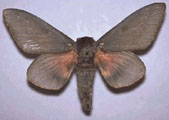 Larval Host |
Propagation
Description: Propagate by seed.Seed Treatment: Seeds require no pretreatment.
Commercially Avail: yes
Find Seed or Plants
View propagation protocol from Native Plants Network.
National Wetland Indicator Status
| Region: | AGCP | AK | AW | CB | EMP | GP | HI | MW | NCNE | WMVE |
| Status: | FACU | FACU | FACU | FACU |
Bibliography
Bibref 1186 - Field Guide to Moths of Eastern North America (2005) Covell, C.V., Jr.Bibref 1185 - Field Guide to Western Butterflies (Peterson Field Guides) (1999) Opler, P.A. and A.B. Wright
Search More Titles in Bibliography
Web Reference
Webref 3 - Flora of North America (2014) Missouri Botanical Garden, St. Louis, MO & Harvard University Herbaria, Cambridge, MA.Additional resources
USDA: Find Pinus rigida in USDA PlantsFNA: Find Pinus rigida in the Flora of North America (if available)
Google: Search Google for Pinus rigida
Metadata
Record Modified: 2022-09-21Research By: TWC Staff