Native Plants

Plant Database
Search for native plants by scientific name, common name or family. If you are not sure what you are looking for, try the Combination Search or our Recommended Species lists.
Reveal, James L.
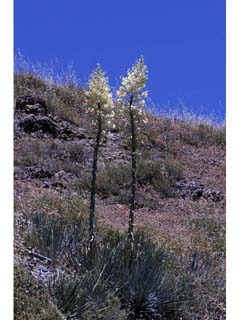
Hesperoyucca whipplei
Hesperoyucca whipplei (Torr.) Baker
Our Lord's Candle, Chaparral Yucca, Foothill Yucca, Quixote Yucca
Agavaceae (Century-Plant Family)
Synonym(s): Yucca californica, Yucca graminifolia, Yucca nitida, Yucca whipplei, Yucca whipplei ssp. caespitosa, Yucca whipplei ssp. eremica, Yucca whipplei ssp. intermedia, Yucca whipplei ssp. parishii, Yucca whipplei ssp. percursa, Yucca whipplei var. caespitosa, Yucca whipplei var. graminifolia, Yucca whipplei var. intermedia, Yucca whipplei var. parishii, Yucca whipplei var. percursa, Yucca whipplei var. whipplei
USDA Symbol: hewh
USDA Native Status: L48 (N)
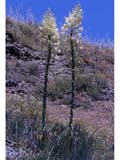
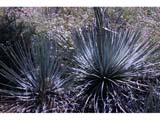
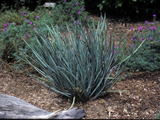
Found from central California east to extreme southwest Arizona and south into Baja California, this yucca has a ground-level rosette of 2 ft., gray-green to bluish, spine-tipped leaves that are decorative without the flowering stalks. When the plant is several years old, it sends up a tall flower stalks which bears hundreds of drooping, waxy, bell-shaped, pale yellow or cream-colored flowers. Several thousand white or cream flowers, often tinged with purple, in a long massive cluster on a stout stalk growing from a dense basal rosette of gray-green, rigid, spine-tipped leaves.
This is the showiest of the yuccas; hundreds in bloom provide a spectacular sight on brushy slopes. The plants die after flowering. All yuccas have a reciprocal relationship with Yucca Moths. After gathering pollen from the flowers and rolling the pollen into little balls, the moths lay their eggs in the ovaries of other flowers and then pack the pollen into holes on the stigma, thus both pollinating the flower and ensuring seed production. The larvae feed on a fraction of the developing seeds, then burrow out of the fruit when mature.


Plant Characteristics
Duration: PerennialHabit: Cactus/Succulent
Leaf Retention: Evergreen
Leaf Complexity: Simple
Fruit Type: Capsule
Leaf: Gray-Green
Bloom Information
Bloom Color: White , YellowBloom Time: May , Jun
Distribution
USA: AZ , CANative Distribution: S. CA and extreme southwestern AZ south into Baja California
Native Habitat: Dry stony slopes, chaparral, and mountains, 1000-4000 ft.
Growing Conditions
Water Use: LowLight Requirement: Sun
Soil Moisture: Dry
CaCO3 Tolerance: Medium
Soil Description: Dry, stony soils.
Conditions Comments: The Yucca moth is the only pollinator of this species. Because it is doubtless absent in a planned landscape, this yucca will not produce seeds from the flowers. Hand pollination is possible, but seeds are available from commercial sources. Since the plants die after fruiting, be sure to plant the seeds several years in succession.
Benefit
Conspicuous Flowers: yesPropagation
Description: Yuccas will germinate promptly from fresh seed held over winter. Seeds germinate best in 60-70 degree temperatures. Yuccas may also be grown from rhizomes, stem cuttings, or by digging offsets from the side of established plants. Transplant into a wellSeed Collection: Gather capsules as they begin to dry but before they split. Allow to dry, then crush to remove seeds. Overwinter, keep seeds in moist sand in the refrigerator. For longer storage periods, keep in sealed, refrigerated containers.
Seed Treatment: No treatment is necessary, but germination may be enhanced by soaking the seeds in water for two days before planting.
Commercially Avail: yes
From the National Organizations Directory
According to the species list provided by Affiliate Organizations, this plant is on display at the following locations:Santa Barbara Botanic Garden - Santa Barbara, CA
Bibliography
Bibref 995 - Native Landscaping from El Paso to L.A. (2000) Wasowski, S. and A. WasowskiSearch More Titles in Bibliography
Additional resources
USDA: Find Hesperoyucca whipplei in USDA PlantsFNA: Find Hesperoyucca whipplei in the Flora of North America (if available)
Google: Search Google for Hesperoyucca whipplei
Metadata
Record Modified: 2018-12-14Research By: TWC Staff