Native Plants

Plant Database
Search for native plants by scientific name, common name or family. If you are not sure what you are looking for, try the Combination Search or our Recommended Species lists.
Bloodworth, Stefan
Halesia diptera
Halesia diptera Ellis
Two-wing Silverbell, Two-winged Silverbell, Silverbell, American Snowdrop Tree, Snowdrop Tree, Snowbell, Cowlicks
Styracaceae (Storax Family)
Synonym(s): Halesia diptera var. magniflora
USDA Symbol: hadi3
USDA Native Status: L48 (N)
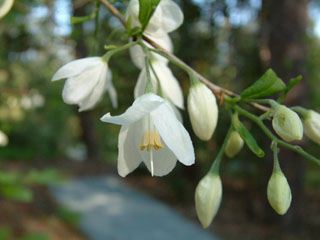
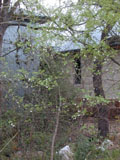
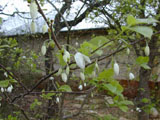
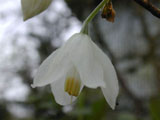
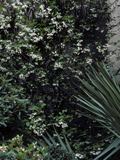
A small, rounded tree or shrub, two-winged silverbell or American snowdrop tree is usually multi-stemmed or low-branched. The plant usually grows 3-15 feet high and has alternate leaves 2-7 inches long and half as wide, with distinct veins. Deciduous leaves are dark-yellow-green in summer, changing to yellow in fall. The white, tubular flowers hang on long, pendulous pedicels and are about 1 inch across and consist of 4 waxy petals with a tight cluster of stamens in the center, looking somewhat like a white candle in a white candle holder. A two-winged fruit cures tan for fall. The bark of young trees is striped and becomes furrowed in an interesting pattern with age. It is native to southeastern North America from South Carolina south to Florida, west to Arkansas and southeast Texas.
The common and scientific names both refer to the two-winged fruit. This immature sour green fruit is consumed by wildlife, including squirrels.

Plant Characteristics
Duration: PerennialHabit: Shrub , Tree
Leaf Retention: Deciduous
Leaf Arrangement: Alternate
Leaf Complexity: Simple
Leaf Venation: Pinnate
Leaf Margin: Entire
Fruit Type: Nut
Size Notes: Up to about 35 feet tall, often much shorter.
Flower: Flowers 1 inch bells.
Fruit: Nut-like, with 2 or 4 wings.
Bloom Information
Bloom Color: WhiteBloom Time: Mar , Apr , May , Jun
Distribution
USA: AL , AR , FL , GA , LA , MS , SC , TXNative Distribution: SC to AR, s. to FL & TX
Native Habitat: Rich woods; swamp margins
Growing Conditions
Water Use: MediumLight Requirement: Part Shade
Soil Moisture: Dry
Soil pH: Acidic (pH<6.8)
Soil Description: Rich, well-drained soils. Sandy, Sandy Loam, Medium Loam, Acid-based
Conditions Comments: This species blooms 1-2 weeks later than H. carolina. Though not drought-tolerant, this species seems to adapt to other cultural extremes. A common variety, var. magniflora, is more heavily flowered and drought-tolerant than the species.
Propagation
Description: Cuttings are difficult to root; those that do root should not be transplanted until growth flushes the following spring. Seeds require a period of after-ripening followed by cold, moist stratification.Seed Collection: Collect fruit from early fall to early winter. Air dry to prevent molding or rotting. Store in sealed, refrigerated containers.
Commercially Avail: yes
National Wetland Indicator Status
| Region: | AGCP | AK | AW | CB | EMP | GP | HI | MW | NCNE | WMVE |
| Status: | FAC | FAC | FAC |
From the National Organizations Directory
According to the species list provided by Affiliate Organizations, this plant is on display at the following locations:Delaware Nature Society - Hockessin, DE
Crosby Arboretum - Picayune, MS
Mt. Cuba Center - Hockessin, DE
Bibliography
Bibref 298 - Field Guide to Texas Trees (1999) Simpson, B.J.Bibref 1620 - Gardening with Native Plants of the South (Reprint Edition) (2009) Wasowski, S. with A. Wasowski
Bibref 841 - Native Alternatives to Invasive Plants (2006) Burrell, C. C.
Bibref 318 - Native Texas Plants: Landscaping Region by Region (2002) Wasowski, S. & A. Wasowski
Bibref 248 - Texas Wildflowers: A Field Guide (1984) Loughmiller, C. & L. Loughmiller
Search More Titles in Bibliography
Web Reference
Webref 57 - Atlas of Florida Plants (2020) Institute for Systematic BotanyWebref 3 - Flora of North America (2014) Missouri Botanical Garden, St. Louis, MO & Harvard University Herbaria, Cambridge, MA.
Webref 23 - Southwest Environmental Information Network (2009) SEINet - Arizona Chapter
Additional resources
USDA: Find Halesia diptera in USDA PlantsFNA: Find Halesia diptera in the Flora of North America (if available)
Google: Search Google for Halesia diptera
Metadata
Record Modified: 2023-05-23Research By: TWC Staff