Native Plants

Plant Database
Search for native plants by scientific name, common name or family. If you are not sure what you are looking for, try the Combination Search or our Recommended Species lists.
Wasowski, Sally and Andy
Gordonia lasianthus
Gordonia lasianthus (L.) Ellis
Gordonia, Loblolly Bay
Theaceae (Tea Family)
Synonym(s):
USDA Symbol: gola
USDA Native Status: L48 (N)
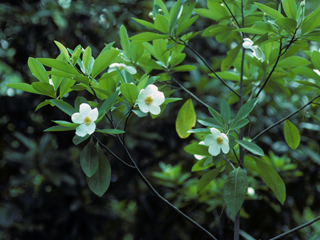
Evergreen tree or shrub with showy, large, white, fragrant flowers; narrow, compact crown of upright branches; and shiny, leathery foliage. Loblolly-bay is a showy, slender, flowering tree with evergreen leaves. Its ultimate size depends on soil moisture, ranging from 30-80 ft. The dark-green, glossy foliage provides a suitable backdrop for numerous large, white flowers. Resembling camellia flowers, five waxy petals surround a mass of golden stamens. The fragrant flowers occur singly at leaf axils but are concentrated at the branch tips, giving the appearance of clusters.
The bark was once used locally for tanning leather. The Latin species name means "hairy-flowered." This genus, honoring James Gordon (1728-91), British nurseryman, includes about 30 species; all the others are in southeastern Asia and Indomalaysia.
Plant Characteristics
Duration: PerennialHabit: Shrub
Leaf Retention: Evergreen
Leaf Pubescence: Glabrous
Leaf Margin: Entire
Leaf Texture: Leathery
Inflorescence: Axillary
Fruit Type: Capsule
Size Notes: Normally 30 to 60 ft high. Tallest on record is 84 feet.
Leaf: Dark Green
Flower: Flowers 2-3 inches wide.
Fruit: Tan
Bloom Information
Bloom Color: WhiteBloom Time: May , Jun , Jul , Aug , Sep , Oct , Nov
Bloom Notes: Bloom period lasts until frost. The fragrant flowers tend to open individually instead of all at once.
Distribution
USA: AL , FL , GA , MS , NC , SCNative Habitat: Wetlands.
Growing Conditions
Water Use: HighLight Requirement: Sun
Soil Moisture: Moist
CaCO3 Tolerance: None
Soil Description: Moist, fertile, acid soils.
Conditions Comments: Though usually seen in wetlands, Loblolly Bay is tolerant of dry, sandy soil, in which it grows in the wild as a large shrub. It does not tolerate drought and will need winter wind and sun protection at the northern limits of its range. The plant can be finicky and short-lived under cultivation unless its natural habitat is closely matched. Root rot can be a problem when young.
Benefit
Use Ornamental: A glossy-leaved evergreen tree with fragrant blooms. Can be used as canopy or understory.Use Wildlife: Deer browse foliage.
Conspicuous Flowers: yes
Fragrant Flowers: yes
Interesting Foliage: yes
Deer Resistant: No
Propagation
Description: Propagate by seed or cuttings. Semi-hardwood or softwood cuttings are used; some authorities say cuttings root easily, others say rooting is sporadic. Sow seeds outdoors in sandy soil. Some will germinate the following year; others require an additionSeed Collection: Gather seeds in late summer when the capsules show signs of splitting. Dry capsules in paper bag until they open.
Seed Treatment: Seed requires no special treatment.
Commercially Avail: yes
Find Seed or Plants
View propagation protocol from Native Plants Network.
Mr. Smarty Plants says
Native evergreens for privacy in Crockett, TX
October 12, 2008
I need advice on what tall evergreens I can plant along a fence line for privacy. I need trees that will be at minimum 8 to 10 feet tall at maturity, are aesthetically pleasing and provide privacy.
...
view the full question and answer
National Wetland Indicator Status
| Region: | AGCP | AK | AW | CB | EMP | GP | HI | MW | NCNE | WMVE |
| Status: | FACW | FACW |
From the National Organizations Directory
According to the species list provided by Affiliate Organizations, this plant is on display at the following locations:Crosby Arboretum - Picayune, MS
Mt. Cuba Center - Hockessin, DE
Bibliography
Bibref 1620 - Gardening with Native Plants of the South (Reprint Edition) (2009) Wasowski, S. with A. WasowskiBibref 841 - Native Alternatives to Invasive Plants (2006) Burrell, C. C.
Search More Titles in Bibliography
Web Reference
Webref 57 - Atlas of Florida Plants (2020) Institute for Systematic BotanyWebref 38 - Flora of North America (2019) Missouri Botanical Garden, St. Louis, MO & Harvard University Herbaria, Cambridge, MA.
Webref 23 - Southwest Environmental Information Network (2009) SEINet - Arizona Chapter
Additional resources
USDA: Find Gordonia lasianthus in USDA PlantsFNA: Find Gordonia lasianthus in the Flora of North America (if available)
Google: Search Google for Gordonia lasianthus
Metadata
Record Modified: 2023-05-23Research By: TWC Staff