Native Plants

Plant Database
Search for native plants by scientific name, common name or family. If you are not sure what you are looking for, try the Combination Search or our Recommended Species lists.
Bransford, W.D. and Dolphia
Gaultheria shallon
Gaultheria shallon Pursh
Salal
Ericaceae (Heath Family)
Synonym(s):
USDA Symbol: gash
USDA Native Status: L48 (N), AK (N), CAN (N)
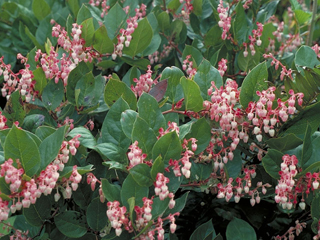
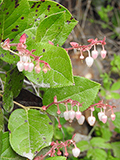
Salal is a dense, robust, thicket-forming subshrub or shrub, usually from 1-4 ft. high, with erect or spreading, intricately branched stems which can root when reclining. The large, leathery, evergreen leaves are round to oval in shape and dull green becoming reddish in winter. A shrub-like plant with spreading or erect, hairy stems, often in large dense patches. Whitish to pale pink, urn-shaped flowers hang along reddish or salmon racemes in upper leaf axils. Flowers are followed by dark-blue fruit.
The fruit is a source of food for wildlife and were once also eaten by coastal Native Americans, one group of whom, the Chinook, gave the plant its common name, Salal. The leaves are often used in flower arrangements.
Plant Characteristics
Duration: PerennialHabit: Shrub
Leaf Retention: Evergreen
Leaf Complexity: Simple
Fruit Type: Capsule
Size Notes: Up to about 6 feet tall, often shorter.
Leaf: Green
Fruit: Purple, Red, Blue
Bloom Information
Bloom Color: White , PinkBloom Time: Apr , May , Jun , Jul
Distribution
USA: AK , CA , OR , WACanada: BC
Native Distribution: Coastal areas from Santa Barbara Co., CA to B.C.
Native Habitat: Coastal woods or brushy places below 2500 ft.
Growing Conditions
Water Use: HighLight Requirement: Sun , Part Shade , Shade
Soil Moisture: Dry , Moist , Wet
CaCO3 Tolerance: None
Soil Description: Moist, peaty soil.
Conditions Comments: This plant must have summer fog or rain and shade. Direct summer sun causes scorch. This easy ground cover can become somewhat invasive.
Benefit
Use Ornamental: Florists use the evergreen branches in arrangements.Use Wildlife: The fruit is a source of food for many animals. Deer browse on new leaves and berries, used as winter browse by deer as well.
Use Food: A staple food of NW coastal First Nations. Can be eaten fresh, cooked and dried. Salal makes excellent jelly.
Conspicuous Flowers: yes
Attracts: Birds , Butterflies , Hummingbirds
Larval Host: Larval host for brown elfin butterfly.
Propagation
Description: The tiny seeds germinate well. Best sown on milled sphagnum moss. Seedlings are slow-growing. Vegetative propagation, using cuttings of new wood taken in late summer, is a faster source of new material. Can also be propagated by layering.Seed Collection: Collect in late summer or fall.
Seed Treatment: No pretreatment is necessary.
Commercially Avail: yes
Find Seed or Plants
Find seed sources for this species at the Native Seed Network.
Mr. Smarty Plants says
Advice on planting Korean dogwood (Cornus kousa) in Vancouver, BC
October 26, 2007
I live in the Vancouver, BC - Pacific Northwest area and the front of our yard faces south to southwest. If I were to plant a tree other than an evergreen, would the Korean Dogwood thrive in this are...
view the full question and answer
Alternatives to non-native heather (Calluna vulgaris)
April 27, 2007
I live in Vernon, BC, Canada. I plan to put a heather plant in my garden, but my space is limited. I know that it will grow approx. 2 ft. high and that it likes well drained and acidic soil, but how...
view the full question and answer
National Wetland Indicator Status
| Region: | AGCP | AK | AW | CB | EMP | GP | HI | MW | NCNE | WMVE |
| Status: | FAC | FACU | FACU |
From the National Organizations Directory
According to the species list provided by Affiliate Organizations, this plant is on display at the following locations:Santa Barbara Botanic Garden - Santa Barbara, CA
Native Seed Network - Corvallis, OR
Bibliography
Bibref 841 - Native Alternatives to Invasive Plants (2006) Burrell, C. C.Bibref 1218 - Tending the Wild: Native American Knowledge and the Management of California's Natural Resources (2006) Anderson, M. Kat
Search More Titles in Bibliography
Web Reference
Webref 38 - Flora of North America (2019) Missouri Botanical Garden, St. Louis, MO & Harvard University Herbaria, Cambridge, MA.Webref 23 - Southwest Environmental Information Network (2009) SEINet - Arizona Chapter
Additional resources
USDA: Find Gaultheria shallon in USDA PlantsFNA: Find Gaultheria shallon in the Flora of North America (if available)
Google: Search Google for Gaultheria shallon
Metadata
Record Modified: 2023-02-10Research By: TWC Staff