Native Plants

Plant Database
Search for native plants by scientific name, common name or family. If you are not sure what you are looking for, try the Combination Search or our Recommended Species lists.
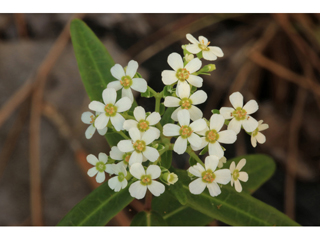
Cressler, Alan
Euphorbia corollata
Euphorbia corollata L.
Flowering Spurge
Euphorbiaceae (Spurge Family)
Synonym(s): Euphorbia corollata var. angustifolia, Euphorbia marilandica, Tithymalopsis corollata, Tithymalopsis marilandica, Tithymalopsis olivacea
USDA Symbol: euco10
USDA Native Status: L48 (N), CAN (N)
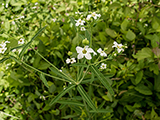
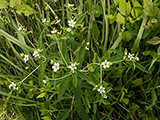
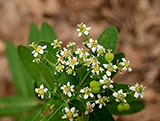
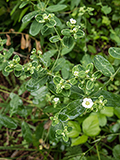
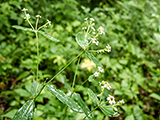
One or more bright green stems grow erect to 3 ft. A whorl of smooth, bright green leaves surrounds the stem at the point where 3-7 flowering stalks branch off. Minute flowers surrounded by 5 white, round, petal-like bracts attached to rim of a cup, all in a few- to much-branched, open cluster atop each stem; sap milky. Each flowering stalk branches again above another whorl of smaller leaves. Flowering stalks are topped by small, white flowers in a large, loose, long-lasting, flat-topped clusters.
The often colored, petal-like bracts are typical of some spurges, as are the stems with milky juice; the flower-like cup-structure (cyathium) is a distinguishing feature of spurges. The common name spurge comes from the Latin expurgare ("to purge"). Snow-on-the-mountain (E. marginata), native to the Midwest, has upper leaves with white edges.
Plant Characteristics
Duration: PerennialHabit: Herb
Fruit Type: Capsule
Size Notes: Up to about 3 feet tall.
Bloom Information
Bloom Color: WhiteBloom Time: Jun , Jul , Aug , Sep , Oct
Distribution
USA: AL , AR , CT , DC , DE , GA , IA , IL , IN , KS , KY , LA , MA , MD , ME , MI , MN , MO , MS , NC , NE , NH , NJ , NY , OH , OK , PA , RI , SC , SD , TN , TX , VA , VT , WI , WVCanada: ON
Native Distribution: NY to s.e. MN & s.e. SD, s. to FL, TX, w. OK & e. KS
Native Habitat: Rocky prairies; open woodlands; fields; roadsides; waste places
Growing Conditions
Light Requirement: SunSoil Moisture: Dry
Drought Tolerance: High
Soil Description: Dry to mesic soils.
Conditions Comments: The milky juice in the stem can cause blisters on sensitive skin.
Benefit
Warning: Flowering Spurge has been used as a laxative, but large doses can be poisonous. Members of this genus are known to fatally poison cattle. Contact with plant, especially its milky sap, can cause irritation of skin, eyes, and mucous membranes. POISONOUS PARTS: All parts. Minor skin irritatation if touched, low toxicity if ingested. Symptoms include nausea, vomiting, diarrhea when ingested. Redness, swelling, blisters after some delay following contact with skin. Toxic Principle: Diterpene esters in milky latex. (Poisonous Plants of N.C.)Conspicuous Flowers: yes
Fragrant Flowers: yes
Value to Beneficial Insects
Supports Conservation Biological ControlThis information was provided by the Pollinator Program at The Xerces Society for Invertebrate Conservation.
Propagation
Propagation Material: Clump Division , Root Cuttings , SeedsDescription: Best propagated by seed sown unstratified in fall or stratified in spring. Easy to divide in spring or fall or to propagate by root cuttings.
Seed Collection: Collect in early Sep. before the seedhead explodes.
Seed Treatment: Moist stratification
Commercially Avail: yes
Find Seed or Plants
Find seed sources for this species at the Native Seed Network.
From the National Organizations Directory
According to the species list provided by Affiliate Organizations, this plant is on display at the following locations:Stengl Biological Research Station - Smithville, TX
Native Seed Network - Corvallis, OR
Bibliography
Bibref 946 - Gardening with Prairie Plants: How to Create Beautiful Native Landscapes (2002) Wasowski, SallyBibref 841 - Native Alternatives to Invasive Plants (2006) Burrell, C. C.
Bibref 1294 - The Midwestern Native Garden: Native Alternatives to Nonnative Flowers and Plants An Illustrated Guide (2011) Adelman, Charlotte and Schwartz, Bernard L.
Search More Titles in Bibliography
Web Reference
Webref 38 - Flora of North America (2019) Missouri Botanical Garden, St. Louis, MO & Harvard University Herbaria, Cambridge, MA.Webref 23 - Southwest Environmental Information Network (2009) SEINet - Arizona Chapter
Additional resources
USDA: Find Euphorbia corollata in USDA PlantsFNA: Find Euphorbia corollata in the Flora of North America (if available)
Google: Search Google for Euphorbia corollata
Metadata
Record Modified: 2023-02-10Research By: TWC Staff