Native Plants

Plant Database
Search for native plants by scientific name, common name or family. If you are not sure what you are looking for, try the Combination Search or our Recommended Species lists.
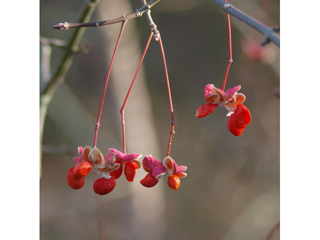
Loveless, Brenda K.
Euonymus atropurpureus
Euonymus atropurpureus Jacq.
Burningbush, Eastern Wahoo, Burning Bush, Wahoo, Waahoo, Whahoo, Spindle Tree
Celastraceae (Bittersweet Family)
Synonym(s): Euonymus atropurpurea
USDA Symbol: euat5
USDA Native Status: L48 (N), CAN (N)
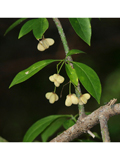
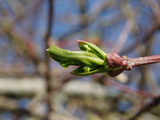
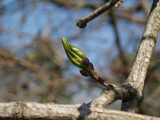
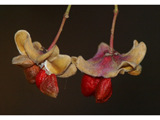
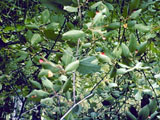
Shrub or rarely a small tree with spreading, irregular crown and red or purple capsules suggesting a burning bush. Eastern wahoo is a large, clumping, deciduous shrub which can develop into a small tree, 20-25 ft. tall. Twigs are lime-green and bordered by corky lines. Leaves are the same lime-green, turning red in fall. Small purple flowers are succeeded by showy fruits. The crimson pods split in mid-autumn to reveal scarlet-coated seeds which hang on far into winter.
The powdered bark was used by American Indians and pioneers as a purgative. "Wahoo" was a Dakota term for the plant, literally meaning arrow-wood. The Latin species name, meaning "dark purple," refers to the color of the fruit.
Plant Characteristics
Duration: PerennialHabit: Shrub
Leaf Retention: Deciduous
Fruit Type: Capsule
Size Notes: Up to about 25 feet tall.
Bloom Information
Bloom Color: PurpleBloom Time: Mar , Apr , May , Jun , Jul , Aug
Distribution
USA: AL , AR , CT , DC , DE , FL , GA , IA , IL , IN , KS , KY , LA , MA , MD , ME , MI , MN , MO , MS , MT , NC , ND , NE , NH , NJ , NY , OH , OK , PA , RI , SC , SD , TN , TX , VA , WI , WVNative Distribution: Ont. to s. MI, MN & ND, s. to FL & e. TX
Native Habitat: Floodplains; stream banks; moist woods
Growing Conditions
Light Requirement: Part ShadeSoil pH: Circumneutral (pH 6.8-7.2)
Soil Description: Fertile, moist soils.
Conditions Comments: Though quite shade-tolerant, this shrub does well in full sun. It is somewhat naturalized in the New York. Plants are susceptible to Euonymus scale and crown gall, and need protection from deer and rabbits. Root suckers may be pulled off if a single-stemmed tree is desired.
Propagation
Description: Semi-hardwood cuttings taken in fall root readily with no hormone treatment. Increase also by separating suckers. A less reliable method of propagation is by seed. Its dense, shallow roots make it easy to transplant when dormant.Seed Collection: Pick seeds by hand just before fleshy capsules begin to split. Air-dry on screens. Store in sealed, refrigerated containers.
Seed Treatment: Seed must be stratified. Some texts say a single stratification at 32-50 degrees for 90-120 days is appropriate. Others say double stratification is necessary … 90 days warm and 60 days cool.
Commercially Avail: yes
National Wetland Indicator Status
| Region: | AGCP | AK | AW | CB | EMP | GP | HI | MW | NCNE | WMVE |
| Status: | FAC | FACU | FACU | FAC | FACU |
Bibliography
Bibref 841 - Native Alternatives to Invasive Plants (2006) Burrell, C. C.Bibref 318 - Native Texas Plants: Landscaping Region by Region (2002) Wasowski, S. & A. Wasowski
Search More Titles in Bibliography
Web Reference
Webref 3 - Flora of North America (2014) Missouri Botanical Garden, St. Louis, MO & Harvard University Herbaria, Cambridge, MA.Additional resources
USDA: Find Euonymus atropurpureus in USDA PlantsFNA: Find Euonymus atropurpureus in the Flora of North America (if available)
Google: Search Google for Euonymus atropurpureus
Metadata
Record Modified: 2022-10-05Research By: TWC Staff