Native Plants

Plant Database
Search for native plants by scientific name, common name or family. If you are not sure what you are looking for, try the Combination Search or our Recommended Species lists.
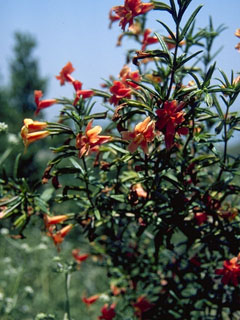
Bransford, W.D. and Dolphia
Diplacus puniceus
Diplacus puniceus Nutt.
Red Bush Monkeyflower, Mission Diplacus
Scrophulariaceae (Figwort Family)
Synonym(s): Diplacus glutinosus var. puniceus, Mimulus glutinosus var. puniceus, Mimulus puniceus
USDA Symbol: dipu4
USDA Native Status: L48 (N)
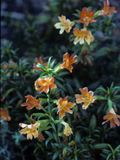
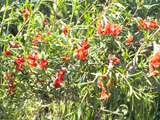
A freely branched subshrub, 2-5+ ft. tall and wide, with narrow, shiny, dark-green leaves that curl and become sticky on hot days. Small, tubular flowers are borne in profusion with the usual monkey face appearance. Flower color range is brick-red or crimson.
Near the coast, flowers will occur almost anytime, but peak flowering is the summer months. The blooms attract hummingbirds.
Plant Characteristics
Duration: PerennialHabit: Shrub
Leaf Retention: Evergreen
Fruit Type: Capsule
Size Notes: Up to about 6 feet tall, often shorter.
Bloom Information
Bloom Color: Red , OrangeBloom Time: Jan , Feb , Mar , Apr , May , Jun , Jul , Aug , Sep , Oct
Distribution
USA: CANative Distribution: Laguna Beach, Santa Ana Mts. & Santa Catalina Id.; adj. Mex.
Native Habitat: Dry slopes & mesas below 2500 ft.
Growing Conditions
Light Requirement: Part ShadeSoil Description: Well-drained soils.
Conditions Comments: Near the coast, flowers will occur almost anytime, but peak flowering is the summer months. Plants will need reshaping as old growth becomes leggy and brittle.
Propagation
Description: Easily started by tip cuttings.Commercially Avail: yes
Find Seed or Plants
Find seed sources for this species at the Native Seed Network.
From the National Organizations Directory
According to the species list provided by Affiliate Organizations, this plant is on display at the following locations:Santa Barbara Botanic Garden - Santa Barbara, CA
Native Seed Network - Corvallis, OR
Bibliography
Bibref 995 - Native Landscaping from El Paso to L.A. (2000) Wasowski, S. and A. WasowskiSearch More Titles in Bibliography
Web Reference
Webref 38 - Flora of North America (2019) Missouri Botanical Garden, St. Louis, MO & Harvard University Herbaria, Cambridge, MA.Webref 23 - Southwest Environmental Information Network (2009) SEINet - Arizona Chapter
Additional resources
USDA: Find Diplacus puniceus in USDA PlantsFNA: Find Diplacus puniceus in the Flora of North America (if available)
Google: Search Google for Diplacus puniceus
Metadata
Record Modified: 2023-02-06Research By: TWC Staff