Native Plants

Plant Database
Search for native plants by scientific name, common name or family. If you are not sure what you are looking for, try the Combination Search or our Recommended Species lists.
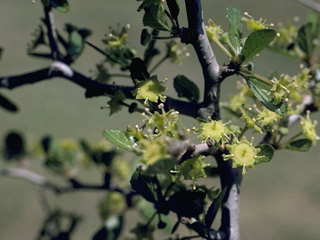
Bransford, W.D. and Dolphia
Colubrina texensis
Colubrina texensis (Torr. & A. Gray) A. Gray
Texas Hog Plum, Texas Snakewood, Texas Colubrina, Hog Plum
Rhamnaceae (Buckthorn Family)
Synonym(s):
USDA Symbol: cote6
USDA Native Status: L48 (N)
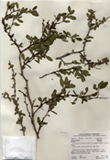
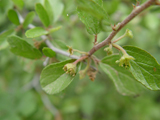
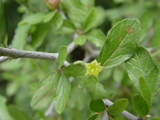
Small, thicket-forming shrub with a rounded crown and a snakeskin-like pattern on the bark. Hog plum is a thicket-forming, rounded shrub rarely over 3-6 ft. Its smooth, gray wood has scaly, brown markings which resemble patterns on snake skin. Slender, twisting branches; small, grayish-green, glossy leaves; and inconspicuous, greenish-yellow flowers are other plant characteristics.
The fruit is eaten by birds and other wildlife, and the plant also provides an important habitat for them.


Plant Characteristics
Duration: PerennialHabit: Shrub
Leaf Retention: Deciduous
Leaf Complexity: Simple
Fruit Type: Capsule
Size Notes: Up to about 6 feet tall.
Bloom Information
Bloom Color: GreenBloom Time: Mar , Apr , May , Jun , Jul
Distribution
USA: TXNative Distribution: Central and west Texas south to Tamaulipas in northeastern Mexico
Native Habitat: Arid, brushy areas
Growing Conditions
Water Use: LowLight Requirement: Part Shade
Soil Moisture: Dry
Cold Tolerant: yes
Soil Description: Well-drained soils. Limestone-based, Sandy, Sandy Loam, Medium Loam, Clay Loam, Clay, Caliche type.
Conditions Comments: Colubrina texensis is disease resistant and grows in poor, dry soils.
Benefit
Use Ornamental: Colubrina texensis is disease resistant and grows in poor, dry soils. The branches have an interesting zizzag structure. The shrub can be useful as a dense, compact hedge plant in poor locations if encouraged by selective pruning.Use Wildlife: The fruit is eaten by deer, javelina, and various birds and other wildlife, and the plant also provides an important habitat for them. Cover, Nesting site, Nectar-insects, fruit-eating birds, fruit-eating mammals.
Attracts: Birds
Propagation
Description: Seed sown directly outdoors in the fall following collection; stratified seed; semi-hardwood tip cuttingsSeed Collection: Gather fruit as it truns black-brown but before it splits apart. If the pulp is still fleshy, it should be removed or allowed to dry on the seed. Fruit collected later in the season is usually dry enough to store intact with the seed. Cold dry storage for one season.
Seed Treatment: Stratification at 41 degrees for 30-40 days
Commercially Avail: yes
Maintenance: Naturally lanky and sparsely-branched, it can be pruned to a nicely-shaped shrub.
From the National Organizations Directory
According to the species list provided by Affiliate Organizations, this plant is on display at the following locations:Lady Bird Johnson Wildflower Center - Austin, TX
Brackenridge Field Laboratory - Austin, TX
Texas Parks and Wildlife Department - Austin, TX
NPSOT - Austin Chapter - Austin, TX
Herbarium Specimen(s)
NPSOT 0740 Collected Apr 2, 1994 in Bexar County by Mike FoxNPSOT 0843 Collected Mar 30, 1994 in Bexar County by Harry Cliffe
NPSOT 0302 Collected Apr 26, 1987 in Bexar County by Harry Cliffe
Wildflower Center Seed Bank
LBJWC-CW-4 Collected 2009-07-31 in Mason County by Lady Bird Johnson Wildflower CenterBibliography
Bibref 354 - Native & Naturalized Woody Plants of Austin & the Hill Country (1981) Lynch, D.Bibref 318 - Native Texas Plants: Landscaping Region by Region (2002) Wasowski, S. & A. Wasowski
Bibref 291 - Texas Wildscapes: Gardening for Wildlife (1999) Damude, N. & K.C. Bender
Bibref 297 - Trees of Central Texas (1984) Vines, Robert A.
Search More Titles in Bibliography
Web Reference
Webref 38 - Flora of North America (2019) Missouri Botanical Garden, St. Louis, MO & Harvard University Herbaria, Cambridge, MA.Webref 23 - Southwest Environmental Information Network (2009) SEINet - Arizona Chapter
Additional resources
USDA: Find Colubrina texensis in USDA PlantsFNA: Find Colubrina texensis in the Flora of North America (if available)
Google: Search Google for Colubrina texensis
Metadata
Record Modified: 2023-05-08Research By: NPC