Native Plants

Plant Database
Search for native plants by scientific name, common name or family. If you are not sure what you are looking for, try the Combination Search or our Recommended Species lists.
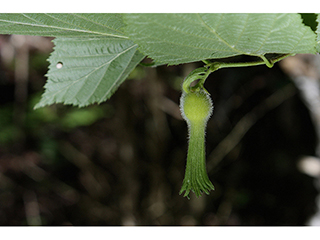
Smith, R.W.
Corylus cornuta
Corylus cornuta Marshall
Beaked Hazelnut, Beaked Filbert
Betulaceae (Birch Family)
Synonym(s):
USDA Symbol: coco6
USDA Native Status: L48 (N), CAN (N), SPM (N)
A dense, mound-shaped, thicket-forming shrub, 4-8 meters tall, or a small tree. Yellowish-brown catkins are showy in late winter and early spring. The female bloom is obscure. The husk that covers the nut is extended, forming a slender beak. Fall color varies from bright yellow to deep wine-red.
The Beaked Hazel is a member of the birch family (family Betulaceae) which includes trees, often large, and some shrubs including alders (Alnus), hornbeams (Carpinus), and hophornbeams (Ostrya), as well as birches (Betula). About 135 species worldwide. About 20 native and 1 naturalized tree species and 8 shrub species in North America.
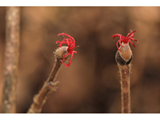
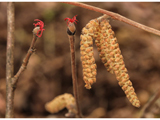
Plant Characteristics
Duration: PerennialHabit: Shrub
Leaf Retention: Deciduous
Leaf Arrangement: Alternate
Leaf Complexity: Simple
Leaf Venation: Pinnate
Breeding System: Flowers Unisexual , Monoecious
Fruit Type: Nut
Size Notes: Shrub up to about 25 feet tall. Sometimes grows as a tree up to about 45 feet tall.
Leaf: Green.
Autumn Foliage: yes
Fruit: Brown.
Bloom Information
Bloom Color: Yellow , Green , BrownBloom Time: Mar , Apr , May
Distribution
USA: AL , CA , CO , CT , DE , GA , IA , ID , IL , MA , MD , ME , MI , MN , MS , MT , NC , ND , NH , NJ , NY , OH , OR , PA , RI , SC , SD , TN , VA , VT , WA , WI , WV , WYCanada: AB , BC , MB , NB , NL , NS , ON , PE , QC , SK
Native Distribution: Nf. to B.C., s. to GA mts., MI, n.e. IA & c. CA
Native Habitat: Upland forests; thickets
Growing Conditions
Water Use: MediumLight Requirement: Sun , Part Shade , Shade
Soil Moisture: Moist
Soil pH: Circumneutral (pH 6.8-7.2)
CaCO3 Tolerance: Medium
Soil Description: Various moist to dry soils.
Conditions Comments: Sometimes considered a more "refined shrub" than C. americana. Can be pruned anytime. Tends to sucker from the roots and must often be thinned out. No extensive disease or insect problems. The west coast variety is Corylus cornuta var. californica.
Benefit
Use Wildlife: The fruit is a smooth nut with a very hard shell.The nuts are rich in protein and fat a favourite of red squirrels and chipmunks. Snowshoe hare browse heavily on young shoots during the winter. The nuts are a preferred food of ruffed grouse, pheasant, hairy woodpecker and blue jay. The winter buds and spring catkins are a valuable protein source for ruffed grouse and American woodcock. (Shrubs of Ontario)
Attracts: Birds , Butterflies
Larval Host: Early Hairstreak (Erora laeta)
Butterflies and Moths of North America (BAMONA)
|
Early Hairstreak (Erora laeta) 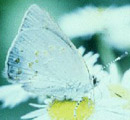 Larval Host |
Propagation
Description: Corylus spp. may be propagated by seed. Rooted pieces may be separated from the plant for increase.Commercially Avail: yes
Find Seed or Plants
View propagation protocol from Native Plants Network.
National Wetland Indicator Status
| Region: | AGCP | AK | AW | CB | EMP | GP | HI | MW | NCNE | WMVE |
| Status: | FACU | FACU | FACU | UPL | UPL | FACU | FACU |
Bibliography
Bibref 1186 - Field Guide to Moths of Eastern North America (2005) Covell, C.V., Jr.Bibref 1185 - Field Guide to Western Butterflies (Peterson Field Guides) (1999) Opler, P.A. and A.B. Wright
Bibref 946 - Gardening with Prairie Plants: How to Create Beautiful Native Landscapes (2002) Wasowski, Sally
Search More Titles in Bibliography
Web Reference
Webref 30 - Calflora (2018) CalfloraWebref 37 - Calscape (2019) California Native Plant Society
Webref 3 - Flora of North America (2014) Missouri Botanical Garden, St. Louis, MO & Harvard University Herbaria, Cambridge, MA.
Webref 23 - Southwest Environmental Information Network (2009) SEINet - Arizona Chapter
Additional resources
USDA: Find Corylus cornuta in USDA PlantsFNA: Find Corylus cornuta in the Flora of North America (if available)
Google: Search Google for Corylus cornuta
Metadata
Record Modified: 2022-10-18Research By: TWC Staff