Native Plants

Plant Database
Search for native plants by scientific name, common name or family. If you are not sure what you are looking for, try the Combination Search or our Recommended Species lists.
Makin, Julie
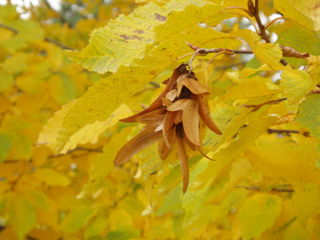
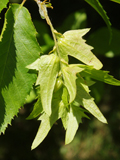
Carpinus caroliniana
Carpinus caroliniana Walter
American Hornbeam, Blue Beech, Water Beech, Musclewood, Ironwood
Betulaceae (Birch Family)
Synonym(s):
USDA Symbol: caca18
USDA Native Status: L48 (N), CAN (N)

Plant Characteristics
Duration: PerennialHabit: Tree
Leaf Retention: Deciduous
Leaf Arrangement: Alternate
Leaf Complexity: Simple
Leaf Venation: Pinnate
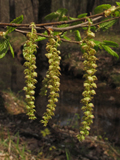
Breeding System: Flowers Unisexual , Monoecious
Fruit Type: Nut
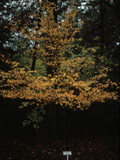
Size Notes: Up to about 40 feet tall.
Leaf: Green
Autumn Foliage: yes
Fruit: Green
Bloom Information
Bloom Color: Red , Green , BrownBloom Time: Mar , Apr , May
Distribution
USA: AL , AR , CT , DC , DE , FL , GA , IA , IL , IN , KY , LA , MA , MD , ME , MI , MN , MO , MS , NC , NH , NJ , NY , OH , OK , PA , RI , SC , TN , TX , VA , VT , WI , WVCanada: NS , ON , QC
Native Distribution: Southern Ontario and central ME s. to c. FL, w. to e. MN, e. IA , AR, & e. TX, with separate populations in central and southern Mexico, Guatemala, and Honduras.
Native Habitat: Shaded woods, Stream, river banks, Flood plains, bottomland
Growing Conditions
Water Use: MediumLight Requirement: Part Shade , Shade
Soil Moisture: Moist
Soil pH: Circumneutral (pH 6.8-7.2)
CaCO3 Tolerance: Low
Soil Description: Moist, rich, deep soils. Sandy, Sandy Loam, Medium Loam, Clay Loam, Clay, Acid-based
Conditions Comments: Blue beech works best as an understory tree in low, shady places, though it shows remarkable adaptability to drier, sunnier sites. It will tolerate periodic flooding. Leaves are occasionally attacked by black mold. It is a slow-grower. The European C. betulus is the more widely plant species but has less desirable fall foliage and its trunk is obscured by lower branching.
Benefit
Use Ornamental: Understory tree, Fall conspicuousUse Wildlife: Fruit-mammals, Fruit-birds.
Use Other: The name Hornbeam has reference to the extreme hardness of the wood - horn"" for toughness, and ""beam,"" an old word for tree. Hornbeam has been utilized for levers and handles of striking implements, but, as it cannot be obtained in large quantities from so small a tree, it is employed chiefly by local tool makers and does not figure as a wood of commerce. (Peattie)"
Attracts: Birds , Butterflies
Larval Host: Eastern Tiger Swallowtail, Striped hairstreak, Red-spotted Purple, Tiger swallow-tail.
Butterflies and Moths of North America (BAMONA)
|
Eastern Tiger Swallowtail (Papilio glaucus) 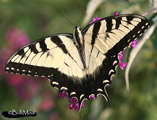 Larval Host |
Striped Hairstreak (Satyrium liparops) 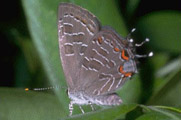 Larval Host |
Propagation
Propagation Material: SeedsDescription: Sow fresh, slightly green seed outdoors in fall or fully dried and stratified seed in spring. Best grown in water permeable, in-ground cloth containers (drip sacks), for the root system is very vigorous.
Seed Collection: Collect nutlets in late summer or early fall when bracts have turned a pale, greenish-brown. Spread on screens to dry, then beat inside a bag to separate seeds from chaff. Place fresh seeds in cold storage.
Seed Treatment: Stratify for 2-3 months at 41 degrees.
Commercially Avail: yes
Find Seed or Plants
View propagation protocol from Native Plants Network.
Mr. Smarty Plants says
Attracting butterflies in Tennessee
July 03, 2009
What flowers and plants do the caterpillars in Tennessee eat? And do you know what butterflies live in Tipton Co. Tennessee?
view the full question and answer
Aging non-native weeping willow in Ohio
June 11, 2008
We had a weeping willow now for about 15 years and it was doing fine until this summer. It has new branches sort of but a lot of the older ones are dying. There are leaves of course and they are sti...
view the full question and answer
National Wetland Indicator Status
| Region: | AGCP | AK | AW | CB | EMP | GP | HI | MW | NCNE | WMVE |
| Status: | FAC | FAC | FAC | FAC | FAC |
From the National Organizations Directory
According to the species list provided by Affiliate Organizations, this plant is on display at the following locations:Pineywoods Native Plant Center - Nacogdoches, TX
Delaware Nature Society - Hockessin, DE
Crosby Arboretum - Picayune, MS
Texas Parks and Wildlife Department - Austin, TX
Georgia Native Plant Society - Atlanta, GA
Mt. Cuba Center - Hockessin, DE
Wildflower Center Seed Bank
LBJWC-1298 Collected 2009-09-15 in Montgomery County by Lady Bird Johnson Wildflower CenterBibliography
Bibref 1186 - Field Guide to Moths of Eastern North America (2005) Covell, C.V., Jr.Bibref 298 - Field Guide to Texas Trees (1999) Simpson, B.J.
Bibref 1185 - Field Guide to Western Butterflies (Peterson Field Guides) (1999) Opler, P.A. and A.B. Wright
Bibref 1620 - Gardening with Native Plants of the South (Reprint Edition) (2009) Wasowski, S. with A. Wasowski
Bibref 841 - Native Alternatives to Invasive Plants (2006) Burrell, C. C.
Bibref 318 - Native Texas Plants: Landscaping Region by Region (2002) Wasowski, S. & A. Wasowski
Bibref 291 - Texas Wildscapes: Gardening for Wildlife (1999) Damude, N. & K.C. Bender
Search More Titles in Bibliography
Web Reference
Webref 3 - Flora of North America (2014) Missouri Botanical Garden, St. Louis, MO & Harvard University Herbaria, Cambridge, MA.Additional resources
USDA: Find Carpinus caroliniana in USDA PlantsFNA: Find Carpinus caroliniana in the Flora of North America (if available)
Google: Search Google for Carpinus caroliniana
Metadata
Record Modified: 2022-10-03Research By: TWC Staff