Native Plants

Plant Database
Search for native plants by scientific name, common name or family. If you are not sure what you are looking for, try the Combination Search or our Recommended Species lists.
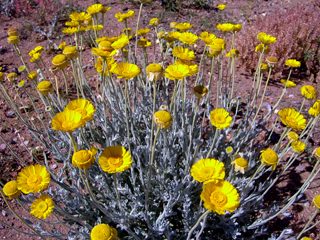
Muller, Thomas L.
Baileya multiradiata
Baileya multiradiata Harv. & A. Gray ex A. Gray
Desert Marigold, Showy Desert Marigold, Paper Daisy, Desert Baileya
Asteraceae (Aster Family)
Synonym(s): Baileya multiradiata var. thurberi
USDA Symbol: bamu
USDA Native Status: L48 (N)
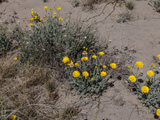
Showy desert marigold is a 12-18 in., mound-shaped biennial or short-lived perennial. Its daisy-like flowers form impressive mounds of nearly solid yellow. The long-lasting, bright-yellow flowers rise on nearly leafless stems above the mounds of woolly, gray foliage. A grayish, woolly plant, branched and leafy mostly in the lower half, with brilliant yellow flowers in heads, one borne at the end of each of many nearly leafless flower stalks. The flowers, which occur sporadically over a long bloom period, turn papery with age.
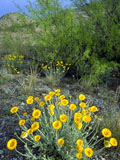
Dense patches often form solid strips of yellow along miles of desert roadsides. In gardens a single plant grows into a perfect hemisphere of yellow, blooming throughout the hot summer and into fall.
The name Marigold, given to several species of Asteraceae with sunny yellow or orange flowers, comes from “Mary’s Gold,” in honor of the Virgin.

Plant Characteristics
Duration: AnnualHabit: Herb
Size Notes: Usually up to about 18 inches tall. Can be up to 3 feet tall in the right conditions.
Flower: Flowers 1 to 2 inches
Fruit: Fruit is a cypsela (pl. cypselae). Though technically incorrect, the fruit is often referred to as an achene.
Bloom Information
Bloom Color: YellowBloom Time: Mar , Apr , May , Jun , Jul , Aug , Sep , Oct , Nov
Distribution
USA: AZ , CA , NM , NV , TX , UTNative Distribution: Southwestern North America, from s.e. CA, AZ, & s.w. UT, e. to w. TX and s. to Durango and Aguascalientes in north central Mexico
Native Habitat: Flat desert areas
Growing Conditions
Water Use: LowLight Requirement: Part Shade
Soil Moisture: Dry
Soil Description: Sandy or gravelly soils. Caliche type, Sandy, Sandy Loam, Medium Loam, Clay Loam, Clay
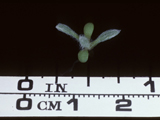
Conditions Comments: Desert marigold is a well-behaved plant that thrives in poor, dry soils and extreme heat. It is subject to crown rot if the soil is too wet. A stand of desert marigold will self-sow in favorable conditions. The seedling rosettes require a period of cold dormancy to set buds.
Benefit
Use Ornamental: An attractive flower that will compare favorably with any of its cultivated relatives, Blooms ornamental, Long-blooming, Grows in clumps, Attractive.Use Wildlife: Nectar-Bees, Nectar-Butterflies, Nectar-insects
Conspicuous Flowers: yes
Value to Beneficial Insects
Special Value to Native BeesThis information was provided by the Pollinator Program at The Xerces Society for Invertebrate Conservation.
Propagation
Propagation Material: SeedsDescription: Plant untreated seeds 1/4" deep in fall or, where winters are more severe, in spring. Germination is erratic, so sow a lot of seeds.
Seed Treatment: No treatment if planted in fall. Spring sown seeds need a moist chilling period.
Commercially Avail: yes
Find Seed or Plants
Find seed sources for this species at the Native Seed Network.
Mr. Smarty Plants says
Native, non-invasive plant seeds for each region in U.S.
June 09, 2006
I need to identify a wildflower from each region that we can package in custom packaging to use as giveaways at our member zoos and aquariums. Our project this year is called Conservation Made Simple...
view the full question and answer
From the National Organizations Directory
According to the species list provided by Affiliate Organizations, this plant is on display at the following locations:Texas Parks and Wildlife Department - Austin, TX
Native Seed Network - Corvallis, OR
Bibliography
Bibref 355 - Landscaping with Native Plants of Texas and the Southwest (1991) Miller, G. O.Bibref 354 - Native & Naturalized Woody Plants of Austin & the Hill Country (1981) Lynch, D.
Bibref 995 - Native Landscaping from El Paso to L.A. (2000) Wasowski, S. and A. Wasowski
Bibref 318 - Native Texas Plants: Landscaping Region by Region (2002) Wasowski, S. & A. Wasowski
Bibref 248 - Texas Wildflowers: A Field Guide (1984) Loughmiller, C. & L. Loughmiller
Bibref 291 - Texas Wildscapes: Gardening for Wildlife (1999) Damude, N. & K.C. Bender
Bibref 328 - Wildflowers of Texas (2003) Ajilvsgi, Geyata.
Search More Titles in Bibliography
From the Archive
Wildflower Newsletter 1989 VOL. 6, NO.2 - Wildflower Network Operates in Louisiana, Wildflower Handbook Published, Researc...Wildflower Newsletter 1990 VOL. 7, NO.2 - Preservation Blooms in Recreated Prairies, New Wildflower Center Prairie Welcome...
Wildflower Newsletter 1995 VOL. 12, NO.3 - Explore the Big Bend With the Wildflower Center, Education Director\'s Report, T...
Additional resources
USDA: Find Baileya multiradiata in USDA PlantsFNA: Find Baileya multiradiata in the Flora of North America (if available)
Google: Search Google for Baileya multiradiata
Metadata
Record Modified: 2021-02-25Research By: TWC Staff